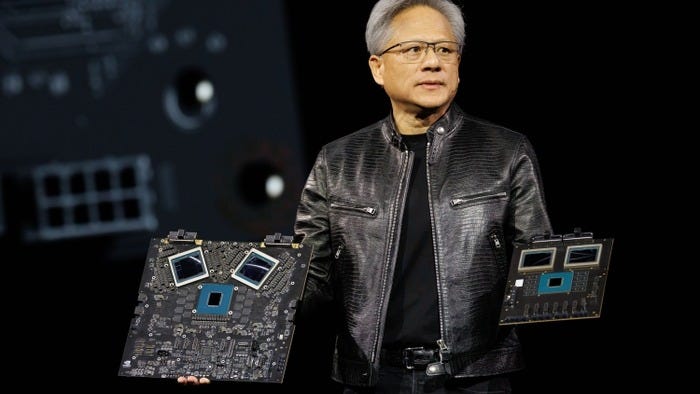
Nvidia and the World Without Jensen
Analysis
The analysis argues that Jensen Huang’s sudden departure from Nvidia could accelerate tougher China export controls and weaken the company’s strategy, leadership, supply chain position, and open-source AI ties. It matters because Nvidia’s business depends heavily on Huang’s personal decisions, customer relationships, supplier commitments, and support for long-term bets.
The authors say Nvidia’s board investigated alleged relationships with a Chinese customer linked to the CCP and with subordinates, while GPU smuggling may also have contributed to Huang’s exit. They claim more than 1.5GW of restricted Nvidia chips reached China and warn that the Remote Access Security Act (RASA) could sharply limit Chinese access, including through remote cloud use.
They argue Nvidia’s flat structure gives Huang about 60 direct reports but leaves few obvious successors. Interim CEO Colette Kress is handling the role, while Ian Buck and Jonah Alben are possible technical candidates, though neither is seen as able to replicate Huang’s broad control.
Without Huang, the authors expect less appetite for risky projects such as autonomous driving and Omniverse, weaker negotiating power with hyperscalers and suppliers, and possible contraction in Nvidia-backed cloud companies. They also fear reduced cooperation with Chinese labs will slow open-source AI and limit innovations that benefit global startups.
The article concludes that Nvidia may become a more conventional, professionally managed company, while U.S. policy likely shifts toward stricter China controls. It presents this as the authors’ analysis, not an established finding; the smuggling and misconduct cases remain under litigation or investigation.
Takeaways
- The article’s central risk thesis is not only succession: it argues that Huang’s exit could remove the personal relationships underpinning Nvidia’s chip allocations, supplier commitments, cloud backstops, and China policy.
- The most consequential watchpoints are the Senate’s treatment of RASA, the outcome of the cited smuggling investigations, and whether Nvidia’s next CEO maintains Huang’s long-term bets and open-source strategy.
Article timeline
Build this article’s timeline
Extract dated events, key actors, and open questions using the same timeline analysis available in Signal.
Log in to build
Timeline generation is available to signed-in community members.
Primary-source excerpts
Login to contribute excerpts from the source.
Five Ws
🤖 4 AI prefills · 1 still unanswered
Who
Jensen Huang, Elon Musk, Mark Zuckerberg, and Nvidia
What
The analysis argues that Jensen Huang’s sudden departure from Nvidia could accelerate tougher China export controls and weaken the company’s strategy, leadership, supply chain position, and open-source AI ties.
When
When did this happen, or what is the timeframe?
Where
China and United States
Why
Centers on Jensen Huang’s resignation from Nvidia, Nvidia GPU smuggling into China, and US export controls on AI chips
Login to answer and earn XP for each gap you fill.
Jensen Huang Succession Jensen Huang, CEO, resignation, succession, leadership China Export Controls China, export controls, GPU smuggling, RASA, MATCH Act Open Source AI Ecosystem open source, Chinese labs, AI models, OSS, DeepEP Nvidia Strategic Bets CUDA, Omniverse, autonomous driving, tensor cores, DGX Cloud Supply Chain Dependence supply chain, Chinese engineers, hyperscalers, chip allocation, GPU production
Key Phrases:
Jensen Huang’s resignation from Nvidia99% Nvidia GPU smuggling into China97% US export controls on AI chips96% RASA legislation93% remote GPU access by Chinese AI labs92% Nvidia’s dependence on China’s supply chain94% open-source AI ecosystem91% CUDA platform90% wide expert parallelism84% flat corporate structure86%
People: Jensen Huang25 Elon Musk2 Mark Zuckerberg Rene Haas Colette Kress3 Ian Buck4 Jonah Alben4 Joe Biden
78
Manipulation Score: High
How much this article uses emotional framing vs. straight reporting
Loaded Language
8625%
Absolutist
6815%
Threat/Panic
8225%
Us vs Them
7215%
Engagement Bait
7820%
Manipulation score look right?
Factual Claims (5)
high
geopolitical
Jensen Huang’s departure from Nvidia could accelerate tougher China export controls and weaken the company’s strategy, leadership, supply chain position, and open-source AI ties.
AI and chip restrictions on China are going to ramp now much faster with the biggest defender Jensen, gone.
medium
economic
Nvidia’s business depends heavily on Huang’s personal decisions, customer relationships, supplier commitments, and support for long-term bets.
The company was uniquely built to suit the man himself.
high
other
Nvidia’s board investigated alleged relationships with a Chinese customer linked to the CCP and with subordinates, while GPU smuggling may also have contributed to Huang’s exit.
Nvidia’s board was investigating Jensen’s conduct and weighing his future at the company he founded
high
geopolitical
More than 1.5GW of restricted Nvidia chips reached China, and RASA could sharply limit Chinese access, including through remote cloud use.
our data shows more than 1.5GW of Nvidia chips, which are restricted, still ultimately ended up in China.
medium
economic
Nvidia’s flat structure gives Huang about 60 direct reports but leaves few obvious successors.
Jensen has roughly 60 direct reports, according to his public statements.
Comments
Login to view and post comments.