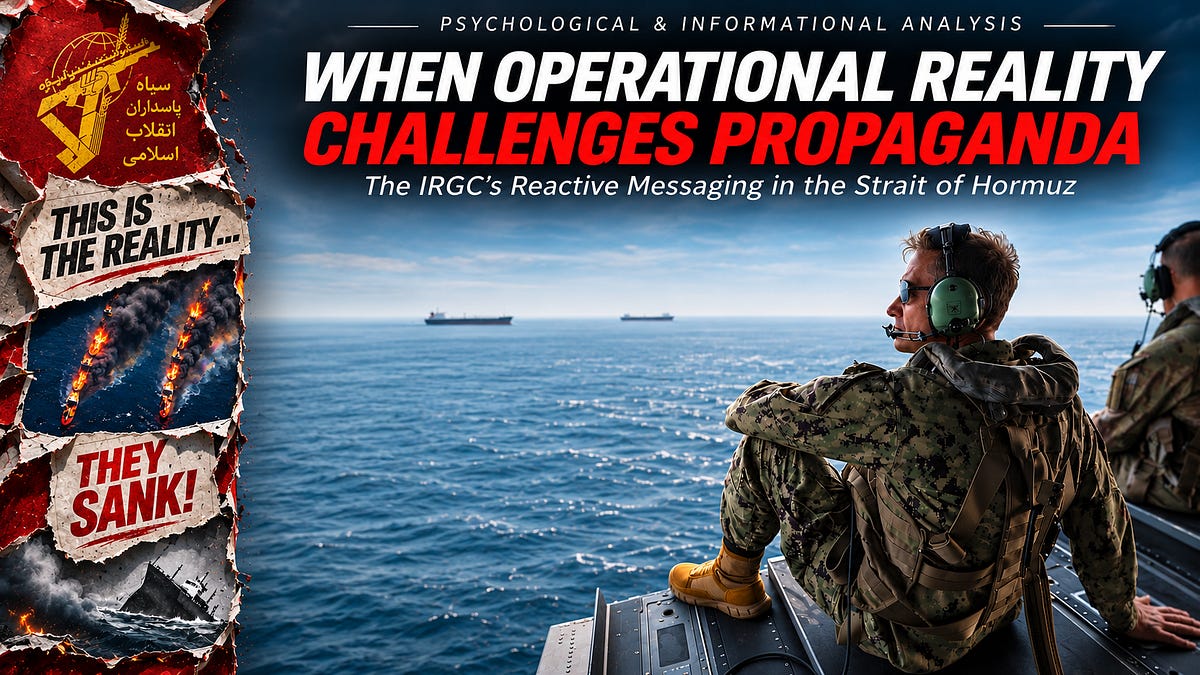
When Operational Reality Challenges Propaganda: The IRGC’s Psychological War Against USCENTCOM
The article argues that the IRGC’s repeated attacks on USCENTCOM Commander Admiral Brad Cooper reflect an intensifying psychological-information campaign over who appears to control the Strait of Hormuz. After CENTCOM publicized Cooper’s October 25 flight over the strait and cited more than 3,000 commercial transits, major oil exports, and the clearing of Iranian sea mines, Iranian military communicators responded with increasingly personalized visual propaganda.
IRGC spokesman Brig. Gen. Hossein Mohebbi first altered Cooper’s photograph to show a burning tanker. After Cooper said Iranian naval forces appeared severely degraded and that he saw no IRGC presence, the IRGC published an image captioned “THEY SANK!” depicting burning vessels and submerged American drones. On November 2, an IRGC-affiliated account claimed that 11 tankers had burned or sunk since Cooper’s visit, though the allegation remains unverified.
The article interprets these messages as efforts to preserve IRGC prestige, discredit Cooper, and convert limited disruption into an appearance of maritime dominance. CENTCOM emphasizes measurable indicators—shipping traffic, cleared routes, and military presence—whereas the IRGC emphasizes fear, destruction, and alleged U.S. losses. This asymmetry allows Iran to influence shipping costs, insurance, and perceptions of risk without demonstrating sustained control of the strait.
The repeated personal targeting of Cooper suggests his statements have become salient to Iranian propagandists. However, the campaign may be counterproductive by amplifying Cooper’s prominence and implicitly acknowledging the challenge posed by U.S. operational messaging.
Article timeline
Build this article’s timeline
Extract dated events, key actors, and open questions using the same timeline analysis available in Signal.
Log in to build
Timeline generation is available to signed-in community members.
Primary-source excerpts
Login to contribute excerpts from the source.
Five Ws
🤖 4 AI prefills · 1 still unanswered
Who
Admiral Brad Cooper, Brigadier General Hossein Mohebbi, Islamic Revolutionary Guard Corps, and United States Central Command
What
The article argues that the IRGC’s repeated attacks on USCENTCOM Commander Admiral Brad Cooper reflect an intensifying psychological-information campaign over who appears to control the Strait of Hormuz.
When
When did this happen, or what is the timeframe?
Where
Strait of Hormuz, Iran, and United States
Why
Centers on IRGC information warfare, psychological operations against USCENTCOM, and Strait of Hormuz
Login to answer and earn XP for each gap you fill.
IRGC Information Warfare IRGC, psychological warfare, propaganda, information operations, narrative dominance Strait Operational Claims Strait of Hormuz, USCENTCOM, maritime security, freedom of navigation, commercial vessels Visual Fear Messaging burning tankers, destroyed vessels, alleged losses, economic disruption, threat imagery Prestige And Resistance institutional prestige, abēru, resistance, moqāvemat, legitimacy Competing Victory Narratives operational reality, perceived dominance, credibility, military effectiveness, deterrence
Key Phrases:
IRGC information warfare98% psychological operations against USCENTCOM97% Strait of Hormuz97% Admiral Brad Cooper95% maritime dominance93% freedom of navigation91% visual intimidation and ridicule89% operational reality versus psychological warfare92% Iranian sea-mine clearance87% maritime insecurity and economic disruption86%
48
Manipulation Score: Medium
How much this article uses emotional framing vs. straight reporting
Loaded Language
5825%
Absolutist
2815%
Threat/Panic
5525%
Us vs Them
5215%
Engagement Bait
3520%
Manipulation score look right?
Factual Claims (10)
medium
military
Admiral Brad Cooper flew over the Strait of Hormuz on October 25, reinforcing USCENTCOM's message of operational confidence and freedom of navigation.
medium
military
CENTCOM reported that more than 3,000 commercial vessels transited the strait with U.S. support over six months.
medium
economic
Gulf partners exported more than 1.5 billion barrels of crude oil since the summer.
high
military
Primary international shipping lanes were cleared of Iranian sea mines.
medium
military
IRGC spokesman Brig. Gen. Hossein Mohebbi posted altered imagery showing a burning oil tanker and later burning vessels and submerged American unmanned aircraft.
high
military
Admiral Cooper stated that Iran's naval forces had been severely degraded and that he observed no IRGC naval presence during his flight.
high
military
An IRGC-affiliated account claimed that 11 oil tankers had burned since Cooper's October 25 visit, with some allegedly sinking.
medium
geopolitical
The IRGC repeatedly personalized attacks against Admiral Cooper as part of an information-warfare campaign.
low
economic
Limited attacks can raise shipping costs, affect insurance premiums, and influence perceptions of maritime risk.
medium
geopolitical
The IRGC's visual narratives cannot independently establish the specific losses they claim or demonstrate sustained control of international shipping lanes.
Comments
Login to view and post comments.