news
War on the Rocks
Deception in Mass Autonomous Warfare
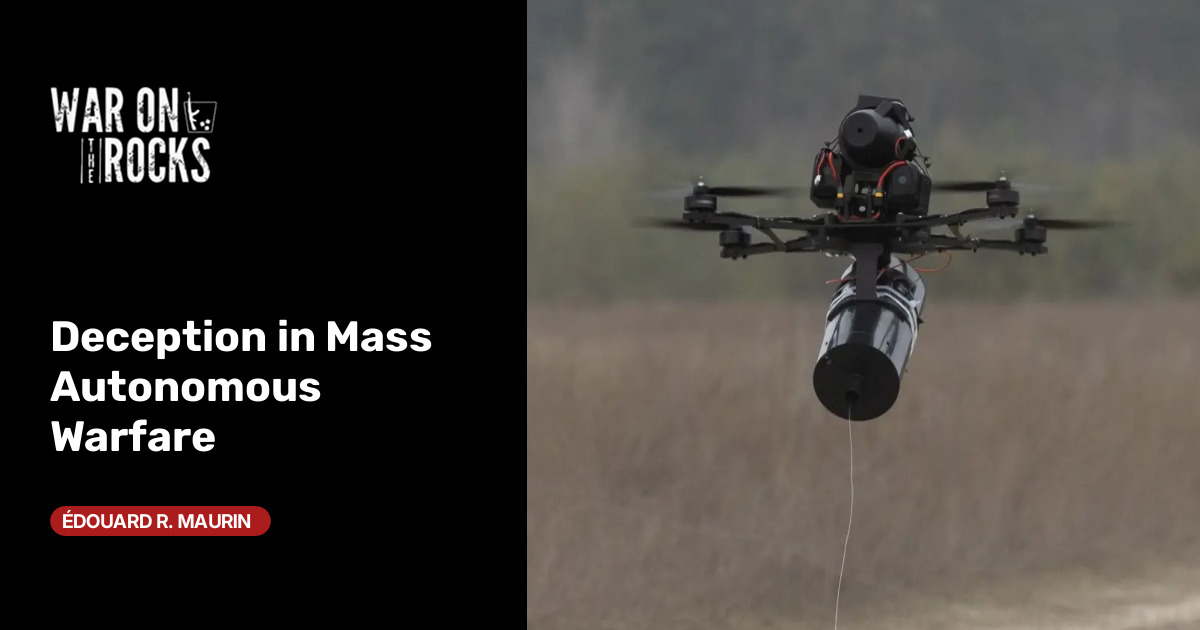
The article argues that deception is becoming essential in modern warfare, particularly on transparent battlefields dominated by drones, sensors, and automated targeting systems. Drawing on an incident near Pokrovsk, the author describes using a fake radio call to provoke Russian forces into revealing that they had infiltrated a trench and captured a prisoner. The tactic simultaneously gathered intelligence, triggered an observable response, and diverted attention from Ukrainian movements.
The author contends that concealment alone cannot protect forces under persistent surveillance. Instead, militaries should coordinate deception across tactical and operational levels, targeting not only enemy commanders but also the automated systems that detect, classify, and prioritize threats. Effective deception should be judged by whether it costs the adversary more to investigate or engage a decoy than it costs the deceiver, and whether it creates freedom of action.
Examples from the war in Ukraine illustrate the economic potential of decoys. Russia has used inexpensive Gerbera and Parodiya drones to overwhelm Ukrainian air defenses, while Ukraine has developed cheaper interceptors and decoys in response. However, the cost advantage is less clear against very cheap first-person-view drones, requiring extremely affordable signature-emitting lures. Even expensive decoys may be worthwhile if they open corridors, preserve valuable assets, saturate decision-making, or reinforce existing enemy assumptions.
The article distinguishes simple saturation from “reflexive control”: constructing a coherent false picture that leads an adversary to make a desired decision independently. Operation Vivaldi is presented as an example combining electronic warfare, information silence, feints, and fabricated battlefield signatures to disrupt Russian awareness and enable Ukrainian advances.
Article timeline
Build this article’s timeline
Extract dated events, key actors, and open questions using the same timeline analysis available in Signal.
Log in to build
Timeline generation is available to signed-in community members.
Primary-source excerpts
Login to contribute excerpts from the source.
Five Ws
🤖 4 AI prefills · 1 still unanswered
Who
Barton Whaley, Turner Shaw, Robert “Magyar” Brovdi, and Fog Defence
What
The article argues that deception is becoming essential in modern warfare, particularly on transparent battlefields dominated by drones, sensors, and automated targeting systems.
When
When did this happen, or what is the timeframe?
Where
Pokrovsk, Kotlyne, and Ukraine
Why
Centers on military deception, mass autonomous warfare, and sensor-fusion chain
Login to answer and earn XP for each gap you fill.
Battlefield Deception Doctrine military deception, stratagems, fake maneuvers, small-unit deception, operational security Autonomous Sensor Warfare autonomous warfare, drones, sensor fusion, automated classification, targeting chains Decoy Economics decoys, attrition, cost exchange, interceptors, profitability Signature Mimicry Systems radar signatures, thermal signatures, radio-frequency emitters, Luneburg lenses, inflatable decoys Ukraine War Case Studies Pokrovsk, Kotlyne, Operation Vivaldi, Russian forces, Ukrainian forces
Key Phrases:
military deception99% mass autonomous warfare96% sensor-fusion chain95% reflexive control95% unmanned aerial assets93% decoys and mimetic signatures93% automated classification chain92% attritional deception90% drone interdiction89% electronic warfare systems89%
31
Manipulation Score: Low
How much this article uses emotional framing vs. straight reporting
Loaded Language
2825%
Absolutist
1815%
Threat/Panic
4225%
Us vs Them
2415%
Engagement Bait
820%
Manipulation score look right?
Factual Claims (10)
high
military
On Jan. 5, 2025, a fake radio call induced Russian forces to investigate the Homar trench at Kotlyne, revealing information about the position.
medium
military
The fighting at Pokrovsk is described as mass autonomous warfare dominated by advanced technology and unmanned aerial assets.
medium
military
Russian strike packages have used Gerbera and Parodiya decoy drones fitted with Luneburg lenses to imitate the radar signatures of armed drones.
high
military
Media reports said decoys made up 50 percent of swarms launched at Ukrainian territory, with the remainder armed.
medium
economic
The Alabuga complex manufactures the decoy drones, whose price is reportedly below $10,000.
medium
economic
A Western surface-to-air interceptor costs several hundred thousand to several million dollars.
low
military
The Department of Defense unit cost for a G-model Javelin missile was $216,717 in Fiscal Year 2021.
medium
economic
Mass-produced first-person-view kamikaze drones can cost about $400 per unit, excluding a specific sensor and explosive payload.
high
military
Operation Vivaldi was conducted in September 2026 and involved Ukrainian strikes, electronic warfare, deception, and the recapture of Nove settlement and its heights.
high
military
Ukrainian officials claimed that electronic-warfare measures disrupted or suppressed around 20,000 Russian drones during Operation Vivaldi.
Comments
Login to view and post comments.