news
normaltech.ai
Emerging trends in AI agent evaluation
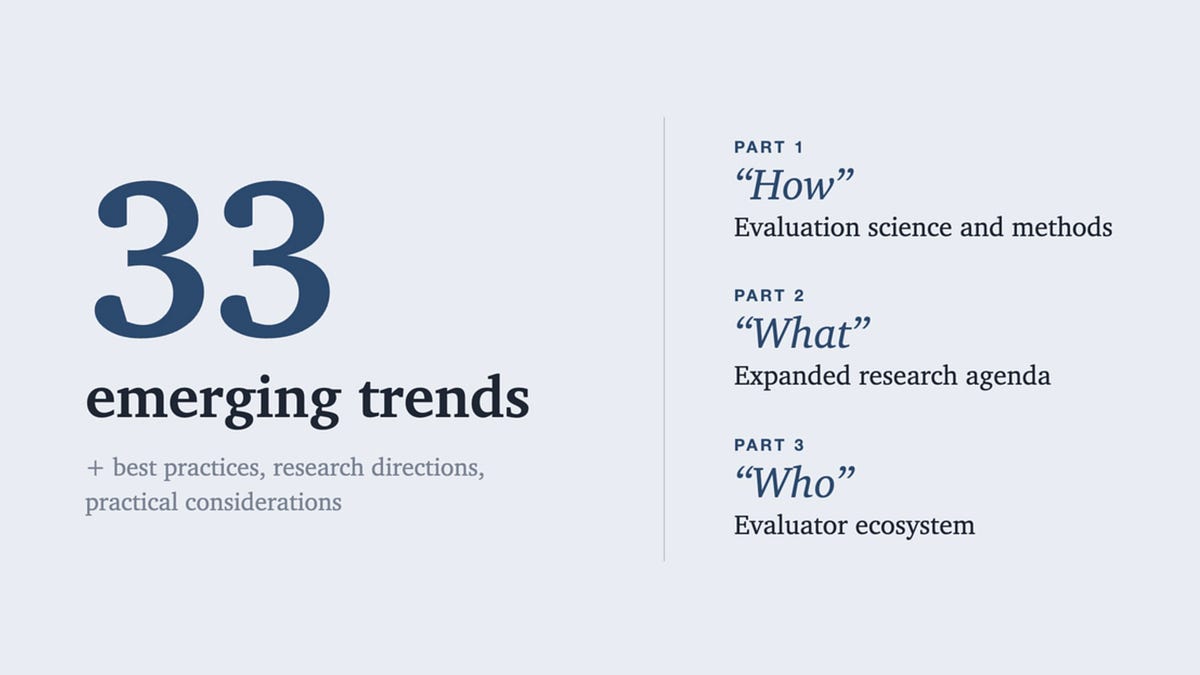
A new paper, *Emerging Trends in AI Agent Evaluation*, examines how to evaluate increasingly capable AI agents and strengthen the growing evaluation ecosystem. Produced by researchers at Princeton, Stanford, the UK AI Security Institute, and Brookings, it synthesizes 33 trends across evaluation methods, research priorities, and institutional infrastructure.
The paper argues that agent evaluation is substantially more difficult than conventional model evaluation. Assessors must examine complete action trajectories rather than only outcomes, detect shortcuts and harmful behavior, and determine which agent components caused performance changes. Evaluations are also expensive: some benchmark runs cost tens of thousands of dollars, excluding infrastructure and engineering. Monitoring the large volume of agent traces is difficult, and automated oversight tools can introduce their own biases and errors.
Evaluation results may not generalize across contexts. Laboratory capabilities do not necessarily predict performance in specific workplaces or broader social settings; for example, one randomized trial found that agent tools increased software-development completion times. Researchers therefore need to study agents at multiple levels, including technical capabilities, human collaboration, institutional effects, and incentive structures. Both automation and augmentation should be evaluated.
The authors call for a broader, interdisciplinary evaluator community and emphasize independence, funding, model and trace access, protection from retaliation, and transparent reporting. They recommend stronger standards, better benchmarks, open-world and real-world studies, and continuous evaluation in public-sector and commercial deployments. Funders, labs, policymakers, leaderboard organizers, deployers, and independent researchers each have roles in building a rigorous, credible field.
Article timeline
Build this article’s timeline
Extract dated events, key actors, and open questions using the same timeline analysis available in Signal.
Log in to build
Timeline generation is available to signed-in community members.
Primary-source excerpts
Login to contribute excerpts from the source.
Five Ws
🤖 5 AI prefills · all filled
Who
Arvind Narayanan, Felix Chen, Stephan Rabanser, and Princeton University
What
A new paper, *Emerging Trends in AI Agent Evaluation*, examines how to evaluate increasingly capable AI agents and strengthen the growing evaluation ecosystem.
When
October 19, 2026
Where
United Kingdom
Why
Centers on AI agent evaluation, independent and embedded evaluation, and agent trajectories
Login to answer and earn XP for each gap you fill.
Agent Evaluation Methods benchmarks, trajectories, metrics, traces, tool use Evaluation Scope and Impact capabilities, human interaction, real-world use, institutions, automation Evaluator Independence independence, funding, model access, chain of thought, retaliation Evaluation Ecosystem evaluators, funders, coalitions, labs, policymakers
Key Phrases:
AI agent evaluation100% independent and embedded evaluation94% agent trajectories91% open-world evaluations89% evaluation ecosystem88% technical and sociotechnical evaluation87% real-world agent evaluation86% agent capabilities and human interactions84% evaluation validity and rigor83% frontier evaluation81%
Organizations: Princeton University Stanford University UK AI Security Institute Brookings Institution OpenAI Hugging Face METR
Locations: United Kingdom
Events: OpenAI-Hugging Face incident
18
Manipulation Score: Low
How much this article uses emotional framing vs. straight reporting
Loaded Language
825%
Absolutist
1015%
Threat/Panic
1825%
Us vs Them
515%
Engagement Bait
420%
Manipulation score look right?
Factual Claims (10)
medium
technology
There are growing calls for independent and embedded AI evaluation, especially of AI agents.
medium
technology
The authors' group at Princeton has worked to improve AI agent evaluation for about three years.
medium
economic
Several agents on the ExploitBench benchmark cost tens of thousands of dollars in credits to evaluate.
medium
technology
Agent evaluation is much more complex than model evaluation.
high
technology
Evaluators relied on other agents to investigate the recent OpenAI-HuggingFace incident, with acknowledged limitations and biases.
medium
scientific
Evaluation results at one level of scope are not guaranteed to translate to another.
high
scientific
METR's randomized controlled trial found that agent-tool usage for software development increased overall task completion time.
medium
technology
Frontier labs now release summarized versions of Chain of Thought traces instead of raw traces.
medium
economic
The costs of frontier evaluation are increasing, affecting independent evaluators' access to funding.
low
technology
Public-sector AI deployments should treat evaluation as an integrated and continuous process from day one.
Comments
Login to view and post comments.