news
Ars Technica
US military ends long-running program to spot nuclear missile launches
In November 1970, a Titan IIIC launched a classified US military payload from Cape Canaveral. The payload was later identified as a Defense Support Program (DSP) satellite, the first in a constellation designed to detect missile launches using infrared sensors. Operating from geosynchronous orbit, DSP satellites became a crucial element of Cold War nuclear deterrence by monitoring for Soviet intercontinental ballistic missiles. Their warning capabilities later supported conventional military operations, including detection of Iraqi Scud launches during the Gulf War.
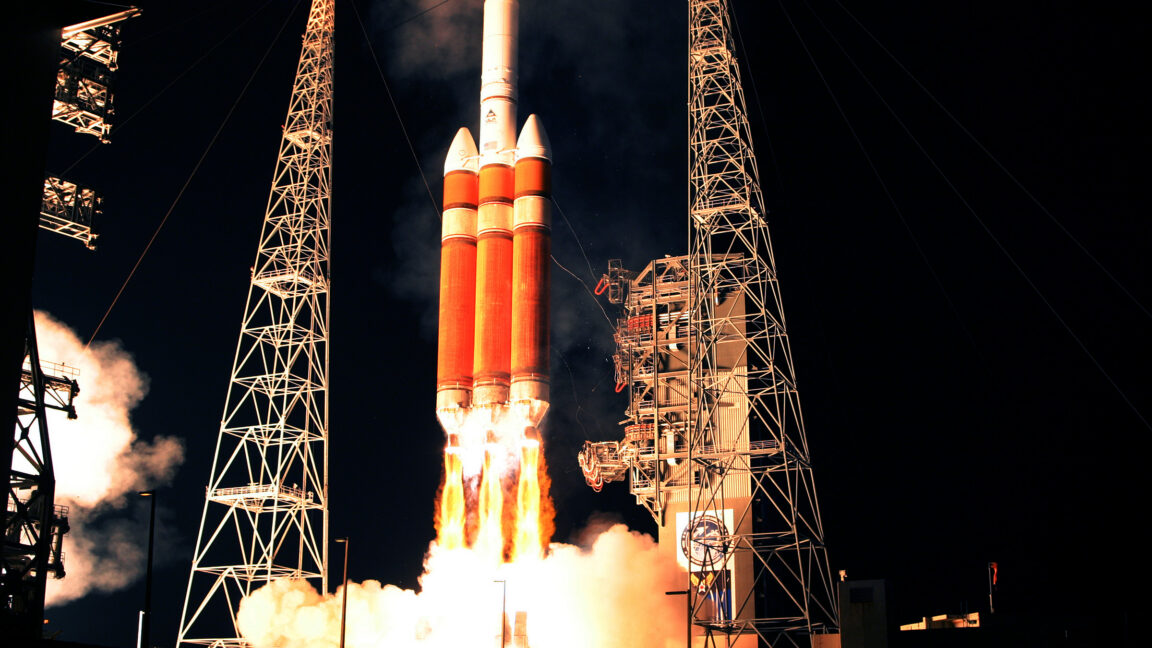
Early DSP satellites weighed about one metric ton and carried roughly 2,000 infrared detectors. Later versions grew to approximately 2.5 tons and included more than 6,000 detectors, with improved reliability and performance. The constellation launched on a wide variety of vehicles—including Titan rockets, Delta IV Heavy, and the Space Shuttle—and remained operational for more than 55 years. DSP satellites continued launching through 2007, with one, DSP-16, deployed from the shuttle Atlantis in 1991.
The program officially ended last month when the final two surviving satellites, believed to be DSP-20 and DSP-22, conducted an orbital maneuver and were raised into graveyard orbits above geostationary space. The Space Force described the retirement as the conclusion of more than half a century of space-based early warning.
DSP has been replaced by the Space Based Infrared System, operational since 2011, whose improved sensors provide greater sensitivity and longer warning times. The military is also developing Next-Generation Overhead Persistent Infrared satellites, with the first potentially launching on a Vulcan rocket within a year.
Article timeline
Build this article’s timeline
Extract dated events, key actors, and open questions using the same timeline analysis available in Signal.
Log in to build
Timeline generation is available to signed-in community members.
Primary-source excerpts
Login to contribute excerpts from the source.
Five Ws
🤖 4 AI prefills · 1 still unanswered
Who
Brandon Davenport, United States military, United States government, and United States Air Force
What
In November 1970, a Titan IIIC launched a classified US military payload from Cape Canaveral.
When
When did this happen, or what is the timeframe?
Where
Space Launch Complex 40, Cape Canaveral, and United States
Why
Centers on Defense Support Program (DSP), space-based early warning, and infrared missile-launch detection
Login to answer and earn XP for each gap you fill.
Defense Support Program DSP satellites, infrared detectors, geosynchronous orbit, missile launches, early warning Satellite Retirement Space Force, final satellites, on-orbit maneuver, graveyard orbit, DSP-20 Infrared Successor Systems Space Based Infrared System, SBIRS, Next-Generation OPIR, improved sensors, warning time Launch History Titan IIIC, Cape Canaveral, Space Launch Complex 40, Delta IV Heavy, Space Shuttle Atlantis Military Missile Detection ICBM detection, Scud launches, nuclear warheads, conventional warfare, deployed warfighters
Key Phrases:
Defense Support Program (DSP)100% space-based early warning97% infrared missile-launch detection96% DSP satellite constellation95% geosynchronous orbit91% nuclear deterrence90% Space Force retirement of DSP satellites89% graveyard orbit disposal84% Space Based Infrared System (SBIRS)88% Next-Generation Overhead Persistent Infrared satellites87%
People: Brandon Davenport
8
Manipulation Score: Low
How much this article uses emotional framing vs. straight reporting
Loaded Language
525%
Absolutist
415%
Threat/Panic
825%
Us vs Them
215%
Engagement Bait
1020%
Manipulation score look right?
Factual Claims (10)
medium
military
In late 1970, a Titan IIIC rocket launched from Space Launch Complex 40 carrying a top-secret payload for the US military.
medium
military
The payload was later disclosed to be a Defense Support Program satellite.
medium
technology
The initial Defense Support Program satellites launched from 1970 to 1973 had a mass of about one metric ton and carried about 2,000 infrared detectors.
medium
military
Defense Support Program satellites were launched into geosynchronous orbit to detect nuclear missile launches.
medium
military
The satellites initially monitored Soviet ICBM launches and later helped detect Iraqi Scud missile launches.
medium
technology
Later satellites in the program had more than 6,000 infrared detectors and a mass of about 2.5 tons.
medium
technology
Defense Support Program satellites continued launching through 2007, including DSP-16, which launched aboard Space Shuttle Atlantis in 1991.
high
military
The final two surviving Defense Support Program satellites participated in an on-orbit maneuvering exercise and subsequently raised their orbits by a few hundred kilometers.
high
military
The US Space Force confirmed that the maneuver marked the official retirement of the Defense Support Program.
medium
technology
The Space Based Infrared System began launching in 2011, and Next-Generation Overhead Persistent Infrared satellites are being developed as successors.
Comments
Login to view and post comments.