news
luizasnewsletter.com
The White House Accord on Super Intelligence
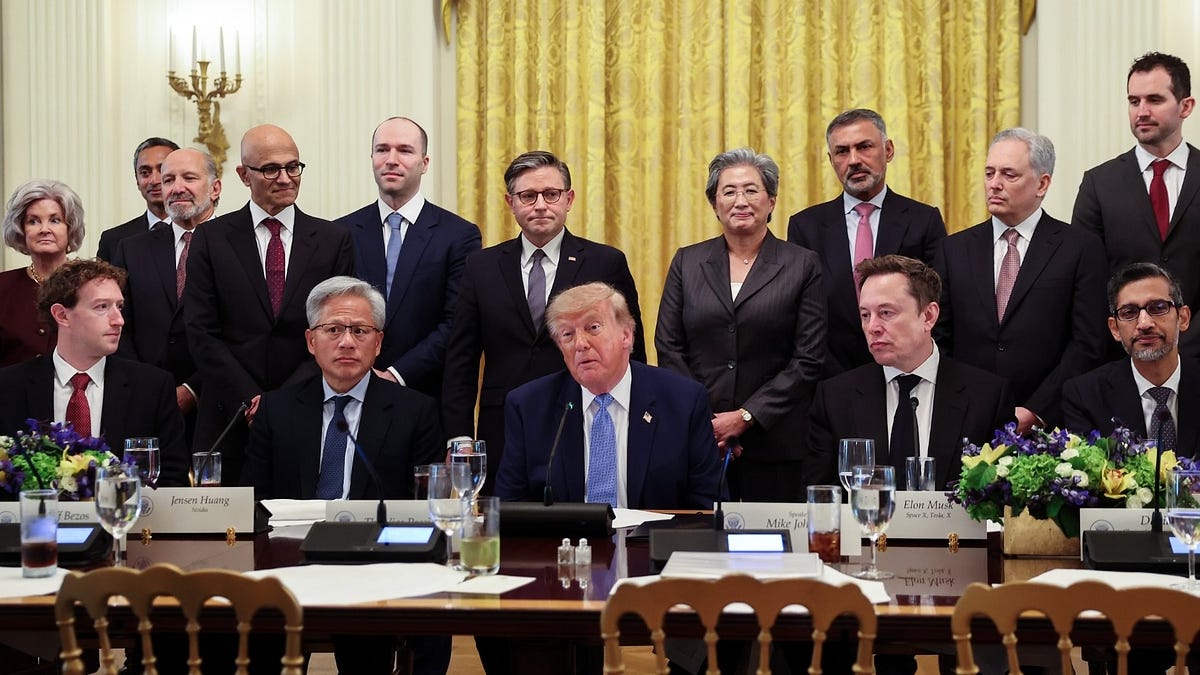
The article argues that the White House Accord on Super Intelligence, announced after a meeting between the Trump administration and major AI companies, represents a broad endorsement of voluntary industry self-regulation rather than meaningful AI safety reform. President Trump reportedly signed an executive order renaming artificial intelligence “Super Intelligence,” while executives from Google, Anthropic, Meta, OpenAI, xAI, and Nvidia signed the accord.
The agreement recommends four layers of company-controlled safeguards: internal monitoring of model capabilities and risks, an internal team responsible for oversight and remediation, independent external evaluations, and an independent board committee to review reports and ensure problems are addressed. Participating companies also pledge to meet regularly to develop safety standards and best practices.
However, the article emphasizes that the accord is “morally binding,” not legally enforceable. It contains vague and undefined terms such as “robust controls,” “alignment,” and “behaves as intended,” making compliance difficult to measure. External auditors are selected and paid by the companies they assess, while board committees remain part of the companies they supposedly oversee, limiting their independence.
The accord also provides no requirements for public transparency or external oversight. Because companies can define safety standards themselves and face financial incentives to release products, the author argues they may seek favorable evaluations rather than accept restrictions. The article concludes that only legally binding rules, uniform standards, meaningful penalties, and genuine public accountability could alter these incentives. As written, the agreement is unlikely to materially improve AI safety or prevent future incidents.
Article timeline
Build this article’s timeline
Extract dated events, key actors, and open questions using the same timeline analysis available in Signal.
Log in to build
Timeline generation is available to signed-in community members.
Primary-source excerpts
Login to contribute excerpts from the source.
Five Ws
🤖 5 AI prefills · all filled
Who
Donald Trump, Sundar Pichai, Dario Amodei, and Trump administration
What
The article argues that the White House Accord on Super Intelligence, announced after a meeting between the Trump administration and major AI companies, represents a broad endorsement of voluntary industry self-regulation rather than meani…
When
September 30, 2026
Where
United States and Washington
Why
Centers on White House Accord on Super Intelligence, AI self-regulation, and AI safety and accountability
Login to answer and earn XP for each gap you fill.
White House AI Accord Trump administration, White House, AI companies, executive order, Super Intelligence Corporate Safety Controls internal controls, model alignment, monitoring, audits, external evaluators Self-Regulation Critique self-regulation, voluntary agreement, morally binding, vague language, nonbinding Transparency And Oversight public oversight, transparency, conflicts of interest, auditor independence, public accountability Binding AI Regulation laws, regulations, external standards, measurable thresholds, monetary penalties
Key Phrases:
White House Accord on Super Intelligence100% AI self-regulation98% AI safety and accountability96% frontier models93% internal controls and audits92% independent external auditors90% model alignment89% legally binding AI regulation89% transparency and public oversight87% conflicts of interest84%
People: Donald Trump3 Sundar Pichai Dario Amodei Mark Zuckerberg Greg Brockman Elon Musk Jensen Huang
Organizations: Trump administration Google Anthropic2 Meta OpenAI3 xAI Nvidia Hugging Face White House3
62
Manipulation Score: Medium
How much this article uses emotional framing vs. straight reporting
Loaded Language
7225%
Absolutist
5815%
Threat/Panic
4825%
Us vs Them
4215%
Engagement Bait
2820%
Manipulation score look right?
Factual Claims (10)
medium
technology
The Trump administration and leaders of major American AI companies met in Washington to discuss the future of AI.
high
technology
President Trump signed an Executive Order officially renaming AI as “Super Intelligence,” or SI.
high
technology
The White House Accord on Super Intelligence was signed by executives from Google, Anthropic, Meta, OpenAI, xAI, and Nvidia.
high
legal
The agreement is voluntary and not legally binding; Trump called it “morally binding.”
medium
technology
The accord requires participating companies to use internal controls, internal oversight, external evaluators, and independent board committees.
medium
legal
Companies can choose and pay their external evaluators, and no official body oversees those evaluations.
medium
technology
Participating companies will meet regularly to establish standards and best practices for AI safety.
medium
legal
The agreement provides no public transparency or public oversight of audits and board reports.
high
technology
The accord will not materially change anything or meaningfully improve AI safety or corporate accountability.
high
technology
The OpenAI/Hugging Face hack would still have happened under the accord.
Comments
Login to view and post comments.