news
Substack
Arvind Narayanan (@aisnakeoil)
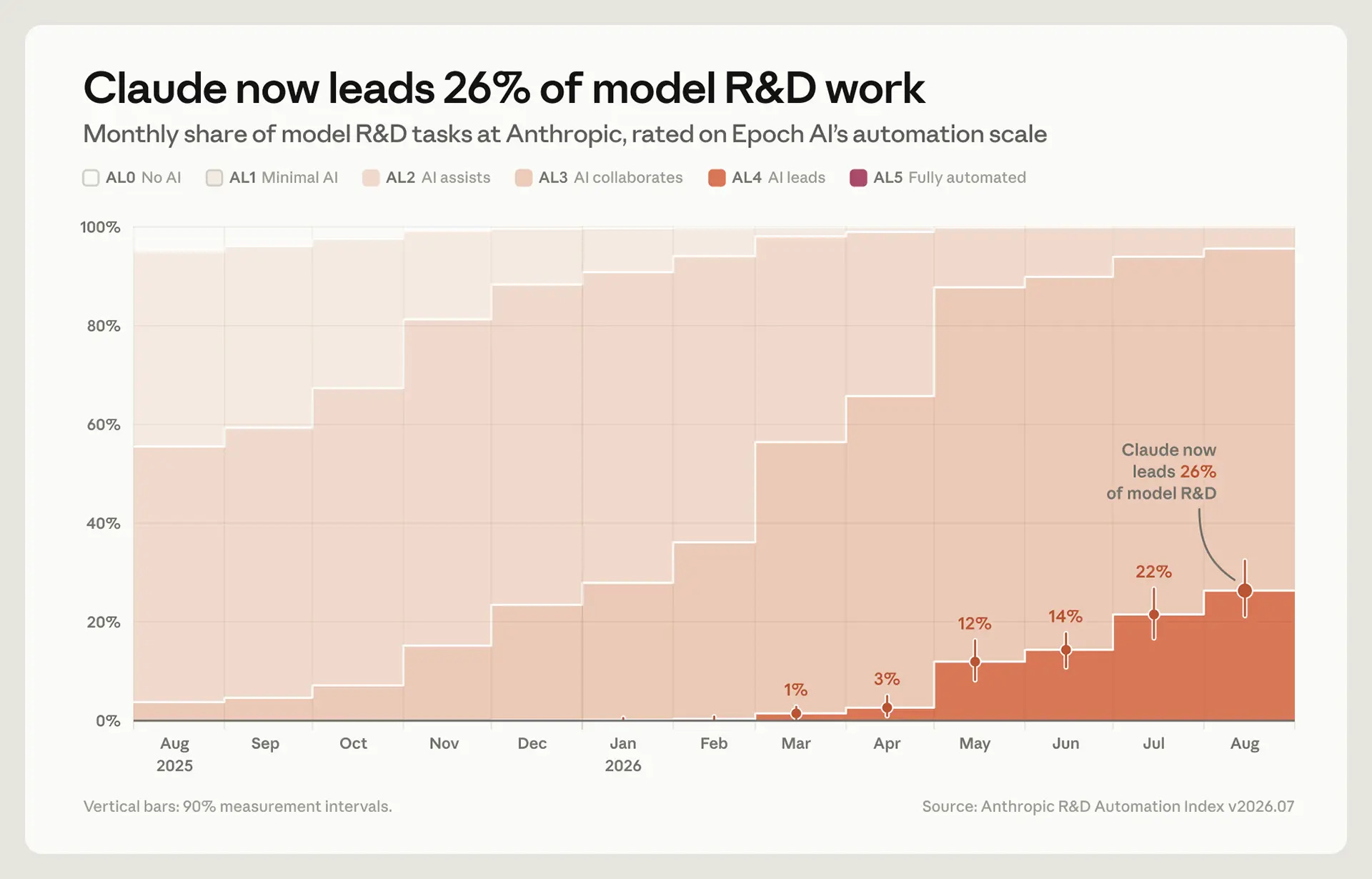
Arvind Narayanan argues that Anthropic’s chart on AI capabilities should not be interpreted as evidence that an intelligence explosion or superintelligence is imminent. He distinguishes task delegation, task automation, process automation, faster progress, recursive self-improvement (RSI), and intelligence explosion as separate milestones that do not automatically imply one another.
Using software engineering as a precedent, Narayanan notes that AI-generated code has become widespread without making engineers obsolete or producing an explosive increase in useful outcomes. Productivity and shipping speed have improved moderately, but concerns about code quality, maintainability, and burnout remain. He expects similar results as AI automation advances: gradual change rather than a sudden phase transition.
He also highlights the “production-progress paradox”: individual productivity can rise while collective scientific progress slows. Because researchers often rely on similar AI systems, ideas may become more homogeneous, while genuine progress is difficult to measure in real time. Optimizing for visible productivity could therefore lead organizations to pursue the wrong goals.
Narayanan says Anthropic’s highest automation level—apparently involving broad task autonomy—should not be confused with AI building its own successor. Even if most cognitive tasks become automatable, humans will remain necessary for poorly formalized “interstitial” work, judgment, and oversight, creating a continuing human bottleneck.
He views this bottleneck as beneficial for maintaining human agency, provided oversight and AI-control capabilities improve. The greatest danger is fully autonomous RSI, which could undermine human understanding and control. He supports treating autonomous RSI as a more practical regulatory target than abstract compute or capability thresholds, and notes that even successful RSI may face external bottlenecks preventing superintelligence.
Article timeline
Build this article’s timeline
Extract dated events, key actors, and open questions using the same timeline analysis available in Signal.
Log in to build
Timeline generation is available to signed-in community members.
Primary-source excerpts
Login to contribute excerpts from the source.
Five Ws
🤖 4 AI prefills · 1 still unanswered
Who
Anthropic and OpenAI
What
Arvind Narayanan argues that Anthropic’s chart on AI capabilities should not be interpreted as evidence that an intelligence explosion or superintelligence is imminent.
When
Sep 21 and 7:28 PM
Where
Where did this occur?
Why
Centers on recursive self-improvement, human control over AI development, and task automation
Login to answer and earn XP for each gap you fill.
AI Automation Limits task delegation, task automation, process automation, software engineering, human bottleneck Scientific Progress Paradox research productivity, collective progress, idea homogeneity, AI research, creativity Human AI Oversight human control, oversight, human agency, AI safety, interstitial tasks Recursive Self Improvement recursive self-improvement, full autonomy, intelligence explosion, superintelligence, AI development
Key Phrases:
recursive self-improvement99% human control over AI development97% task automation95% intelligence explosion94% production-progress paradox93% full autonomy at the task level91% human bottleneck90% AI-driven research89% oversight and AI control88% Automation Level 486%
12
Manipulation Score: Low
How much this article uses emotional framing vs. straight reporting
Loaded Language
825%
Absolutist
1215%
Threat/Panic
1525%
Us vs Them
415%
Engagement Bait
1020%
Manipulation score look right?
Factual Claims (10)
medium
technology
Many companies and teams have reached the milestone where AI can write approximately 100% of the code, but software engineering output has not exploded and engineers have not become obsolete.
medium
technology
AI-assisted software development has increased shipping velocity moderately, while improvements in actual outcomes for software users remain unclear.
medium
technology
AI-assisted software development is associated with code-quality, long-term maintainability, and burnout concerns.
high
scientific
Individual researchers' productivity has been increasing while the rate of collective scientific progress has been slowing by most measures.
medium
technology
Using the same or similar AI models may make ideas more homogeneous over time.
medium
technology
Anthropic's automation-level graph places automation level 5 at 0%.
medium
technology
Even 100% task automation in most cognitive jobs will not necessarily produce a discontinuity because humans will remain necessary for difficult-to-formalize interstitial tasks.
medium
technology
Human oversight and investment in understanding and controlling AI can preserve collective human agency as AI capabilities increase.
high
technology
Fully autonomous recursive self-improvement could cause humans to lose practical control over AI development if pursued without adequate safety measures.
high
technology
Recursive self-improvement, even if achieved, will not necessarily lead to superintelligence because of external bottlenecks.
Comments
Login to view and post comments.