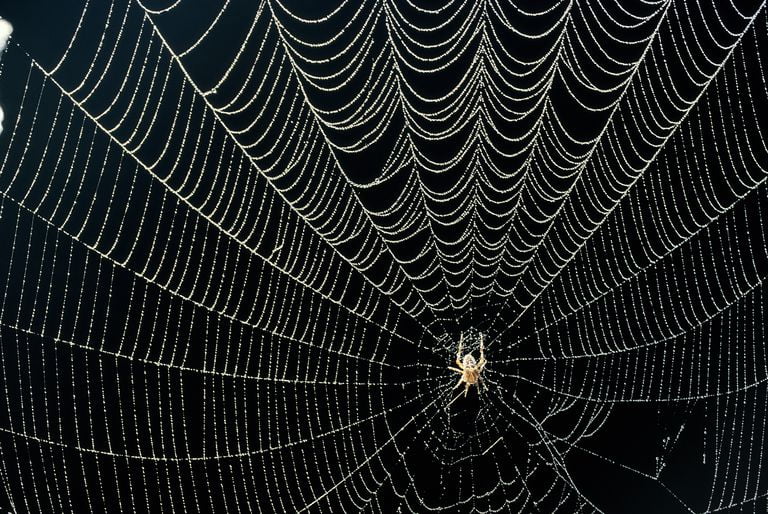
Spider Silk: The New Material Used in Body Armor
The article examines spider silk as a potential next-generation material for military body armor. Spider silk is lightweight, flexible, highly elastic, and exceptionally strong relative to its weight. Its protein-based fibers can be formed into protective meshes, but practical use has historically been limited because producing sufficient quantities was difficult.
The concept of silk armor has existed for centuries. Gottfried Wilhelm Leibniz proposed silk-based armor more than 300 years ago, while physician George Emory Goodfellow later documented cases in which silk garments appeared to resist bullets. A vest made from Golden Orb Spider silk demonstrated the production challenge: it required eight years and approximately one million spiders.
Recent genetic-engineering advances may make large-scale production feasible. Researchers at Utah State University modified silkworm DNA so the insects produced silk containing spider proteins. The resulting material reportedly had twice the strength and greater elasticity of conventional silkworm silk, stopping a slow-moving .22-caliber bullet with four layers, compared with roughly 33 layers of Aramid in standard bulletproof vests.
Kraig Biocraft Laboratories developed a related genetically engineered silk called “Dragon Silk” and announced production of armor panels for the U.S. Army in 2018. More recently, Chinese researchers at Donghua University created transgenic silkworm fibers with reportedly six times the toughness of traditional bulletproof-vest materials. Their findings suggest spider-silk-based fibers could significantly improve protective equipment, though the article does not confirm widespread military deployment or full protection against modern ammunition.
Article timeline
Build this article’s timeline
Extract dated events, key actors, and open questions using the same timeline analysis available in Signal.
Log in to build
Timeline generation is available to signed-in community members.
Primary-source excerpts
Login to contribute excerpts from the source.
Five Ws
🤖 4 AI prefills · 1 still unanswered
Who
Gottfried Wilhelm Leibniz, George Emory Goodfellow, Jon Rice, and United States Army
What
The article examines spider silk as a potential next-generation material for military body armor.
When
When did this happen, or what is the timeframe?
Where
Madagascar, China, and The Netherlands
Why
Centers on spider silk body armor, genetically engineered silkworms, and Dragon Silk
Login to answer and earn XP for each gap you fill.
Spider Silk Properties strength, elasticity, flexibility, protein fibers, bulletproof mesh Silk Armor History Leibniz, Goodfellow, silkworm cocoons, silk vests, bullet resistance Genetic Silk Manufacturing genetically engineered silkworms, DNA modification, spider proteins, transgenic silkworms, gene editing Armor Testing Applications U.S. Army, .22-caliber bullet, Kevlar, Aramid, protective panels Material Science Research Donghua University, fiber structure, nylon, Kevlar, tensile strength
Key Phrases:
spider silk body armor99% genetically engineered silkworms96% Dragon Silk93% bulletproof mesh90% transgenic silkworms89% genetic engineering of spider silk88% high tensile strength and toughness86% mass production of spider silk85% Aramid body armor82% bullet-resistant silk vest80%
18
Manipulation Score: Low
How much this article uses emotional framing vs. straight reporting
Loaded Language
2225%
Absolutist
1215%
Threat/Panic
325%
Us vs Them
115%
Engagement Bait
2820%
Manipulation score look right?
Factual Claims (10)
medium
military
The U.S. Army is considering spider silk as a material for body armor.
medium
scientific
Spider silk is highly flexible, extremely stretchable, and stronger than steel.
medium
other
Gottfried Wilhelm Leibniz proposed creating body armor from silk more than 300 years ago.
medium
other
A vest made using Madagascar's Golden Orb Spider silk required eight years and approximately one million spiders.
medium
scientific
Utah State University researchers genetically altered silkworms to incorporate spider proteins into their silk.
high
military
The resulting hybrid silk stopped a slow-moving .22-caliber bullet using four layers.
high
military
Kraig Biocraft Labs announced in 2018 that it was manufacturing large quantities of Dragon Silk panels for the U.S. Army.
high
scientific
Chinese scientists engineered spider silk that was six times tougher than conventional body armor materials.
medium
scientific
Donghua University researchers created complete polyamide spider-silk fibers using transgenic silkworms.
medium
scientific
Spider-silk fibers may have applications in protective gear and medical technology.
Comments
Login to view and post comments.