news
SingularityHub
Incredible Video of Using Light to Control the Brain of Mice
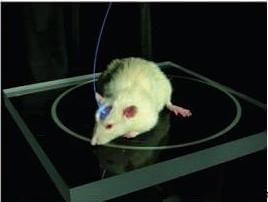
The article describes early optogenetics research at Stanford University, led by Karl Deisseroth, showing how light can be used to control the brains of living mice and rats. Scientists insert genes from algae and archaea into rodent neurons using viruses, making those cells sensitive to light: blue light activates neurons, while yellow light deactivates them. A fiber-optic cable delivers the light directly into the animal’s brain, allowing precise control of specific neurons or brain regions. One striking demonstration is that stimulating one hemisphere of a mouse can make it run in circles.
The piece explains that the technique has broader scientific value beyond dramatic demonstrations. By targeting particular neuron types and signaling pathways, researchers can study the biological basis of mental conditions such as depression, narcolepsy, and motivation. Deisseroth’s team has also used these tools to influence behavior, including creating drug-addicted-like preferences in mice by pairing light stimulation with a “pleasure room.” The article highlights the high spatial and temporal precision of these genetically encoded optical tools, which can control neural signaling on the scale of milliseconds.
At the same time, the article raises ethical concerns about the future of brain manipulation in humans. It suggests that while practical human applications remain years away, optogenetics could eventually be used to alter emotions, desires, or other psychological states. For now, however, the technology is mainly a powerful research tool for understanding the brain and improving treatment for mental illness.
Article timeline
Build this article’s timeline
Extract dated events, key actors, and open questions using the same timeline analysis available in Signal.
Log in to build
Timeline generation is available to signed-in community members.
Primary-source excerpts
Login to contribute excerpts from the source.
Five Ws
🤖 4 AI prefills · 1 still unanswered
Who
Karl Deisseroth, Stanford University, SingularityHub, and Technology Review
What
The article describes early optogenetics research at Stanford University, led by Karl Deisseroth, showing how light can be used to control the brains of living mice and rats.
When
Mar 18, 2010 and 2009
Where
Where did this occur?
Why
Centers on optogenetics, Karl Deisseroth, and rodent neurons
Login to answer and earn XP for each gap you fill.
Optogenetics Research optogenetics, Deisseroth, Stanford, neurons, light Brain Behavior Control mice, rats, behavior, pleasure room, depression Medical Applications treatment, mental illness, epilepsy, human brain, therapy Ethical Concerns mind control, ethics, scary, manipulation, emotion
Key Phrases:
optogenetics100% Karl Deisseroth96% rodent neurons93% fiber optic cable90% genetically encoded optical tool88% signaling pathways85% spatial and temporal resolution83% hypothalamus80% depression78% drug-addicted type behavior76%
People: Karl Deisseroth5
42
Manipulation Score: Medium
How much this article uses emotional framing vs. straight reporting
Loaded Language
3825%
Absolutist
2815%
Threat/Panic
5225%
Us vs Them
1015%
Engagement Bait
6020%
Manipulation score look right?
Factual Claims (10)
medium
technology
Optogenetics lets scientists control rodent neurons with light by inserting genes from algae and archaea.
medium
technology
Blue light turns the neuron on and yellow light turns the neuron off.
medium
technology
A fiber optic cable can be connected into a living mouse or rat to expose different neurons to different lights.
medium
scientific
Stimulating the right hemisphere of a mouse can make it run in circles to the left.
high
scientific
Targeting the hypothalamus can create basal wants and desires in animals.
medium
health
Optogenetics can provide insight into neurological mechanisms behind depression and other mental illnesses.
medium
technology
The Deisseroth Lab created a genetically encoded optical tool called an optoXR.
medium
technology
These tools allow control in the brain with great spatial and temporal resolution.
high
scientific
The lab used signaling pathway control to induce drug-addicted-type behavior in mice.
high
technology
Human brain control through optogenetics is years away, while for mice mind control is already here.
Comments
Login to view and post comments.