news
PetaPixel
A NASA Photo Processing Technique to Study Mars Has Discovered Ancient Art on Earth
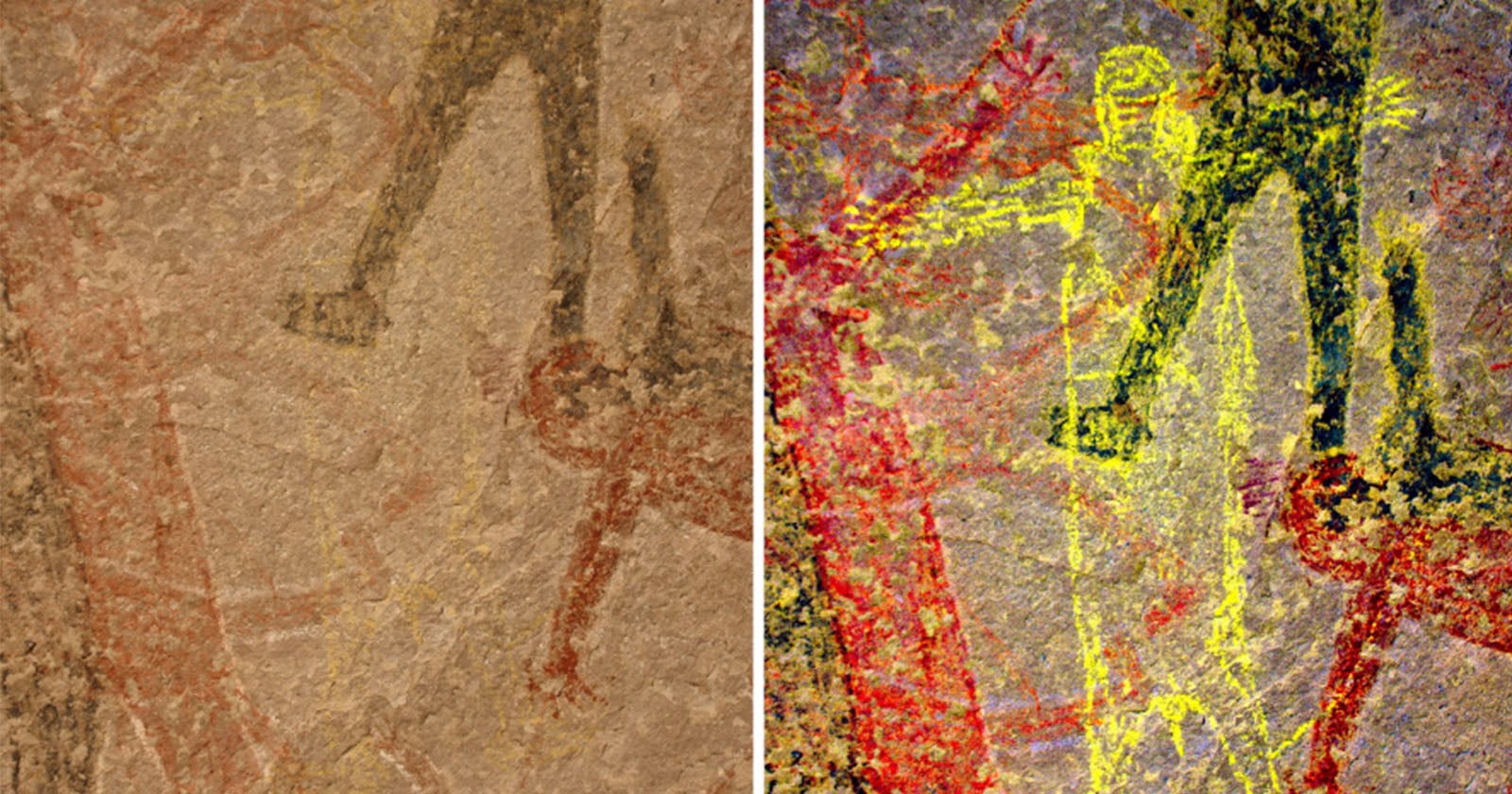
Jon Harman, a rock art enthusiast with a background in medical imaging and a PhD in mathematics, adapted a NASA image-processing method originally designed to enhance details in Mars rover photos to reveal faded ancient artwork on Earth. After seeing a 2005 example of the “decorrelation stretch” technique at a rock art conference, he researched the NASA algorithm and created the Dstretch plug-in for open-source image software, later expanding it into Android and iOS apps.
The technique works by expanding color differences in an image rather than simply increasing contrast, making barely visible pigments and markings easier to see. Harman first tested Dstretch on rock art photos from Baja California, Mexico, where it revealed a yellow figure that had been almost invisible. That success convinced him of its value.
Since then, archaeologists around the world have used Dstretch to uncover undocumented images and details in places including Egypt, Canada, Greece, and Cambodia. It has even been applied to enhance tattoos on mummified remains. One major success came between 2010 and 2012, when archaeologist Noel Hidalgo Tan used the plug-in to identify more than 200 faded paintings around the Angkor Wat temple complex in Cambodia.
Overall, the article highlights how a NASA-developed Mars imaging method was repurposed into a powerful tool for archaeology and rock art research worldwide.
Primary-source excerpts
Login to contribute excerpts from the source.
Five Ws
🤖 4 AI prefills · 1 still unanswered
Who
Jon Harman, Noel Hidalgo Tan, NASA, and Jet Propulsion Laboratory
What
Jon Harman, a rock art enthusiast with a background in medical imaging and a PhD in mathematics, adapted a NASA image-processing method originally designed to enhance details in Mars rover photos to reveal faded ancient artwork on Earth.
When
When did this happen, or what is the timeframe?
Where
Cave of San Borjitas, Baja California, and Mexico
Why
Centers on decorrelation stretch, Dstretch plug-in, and rock art
Login to answer and earn XP for each gap you fill.
📅 Timeline
A Mars image-enhancement method inspired Jon Harman to build Dstretch, turning his long-standing rock art interest into a tool for revealing faded ancient imagery.
- 1980 — Harman develops interest in rock art
- 2005 — Harman creates Dstretch plug-in ❗
- 2005 — Harman sees Mars decorrelation stretch example ❗
- 2005 — Harman tests Dstretch on Baja California rock art ❗
Gaps & open questions:
- How Harman learned software development details from the NASA paper isn't explained.
- The timeline doesn't show when Dstretch spread from one test to wider archaeological use.
- It doesn't explain Noel Hidalgo Tan's role beyond being named in the article metadata.
- What made decorrelation stretch so effective on faded rock art versus standard contrast edits?
- How much did NASA/JPL's Mars imaging work directly shape Dstretch's final design?
- What discoveries or validation efforts followed Harman's first successful Baja California test?
Dstretch Development Dstretch, decorrelation stretch, Jon Harman, plug-in, image processing Rock Art Discovery rock art, cave paintings, ancient artwork, faded figures, archaeologists NASA Image Technique NASA, Mars, decorrelation stretch, satellite photos, visualization Global Archaeology Uses Egypt, Canada, Greece, Cambodia, tattoos
Key Phrases:
decorrelation stretch100% Dstretch plug-in98% rock art96% ancient faded artwork92% image processing technique90% NASA Jet Propulsion Laboratory88% Mars Exploration Rover webpage86% Baja California, Mexico84% color matrices80% medical imaging78%
Organizations: NASA7 Jet Propulsion Laboratory NASA Mars Exploration Rover webpage NASA JPL PetaPixel2
Locations: Cave of San Borjitas Baja California2 Mexico2 Mars7 Earth Rancho Bernardo Egypt Canada Greece Singapore
Events: rock art conference2
6
Manipulation Score: Low
How much this article uses emotional framing vs. straight reporting
Loaded Language
425%
Absolutist
215%
Threat/Panic
025%
Us vs Them
115%
Engagement Bait
820%
Manipulation score look right?
Factual Claims (10)
medium
technology
Jon Harman developed the Dstretch plug-in using a NASA decorrelation stretch technique.
medium
technology
NASA JPL developed decorrelation stretch to improve detail in satellite photos of Mars.
low
technology
Decorrelaton stretch is a visualization tool that enhances color variations among objects in a scene.
medium
social
Harman was inspired by a 2005 rock art conference where he saw NASA Mars images processed with decorrelation stretch.
medium
other
Harman has a background in medical imaging and a PhD in mathematics.
low
geopolitical
Harman first used Dstretch on rock art photos from Baja California, Mexico.
medium
other
The algorithm revealed a yellow figure in the image, convincing Harman of its usefulness.
medium
social
Dstretch has been used by archaeologists worldwide to discover undocumented figures and artwork in places including Egypt, Canada, and Greece.
medium
health
Dstretch has been used to enhance images of tattoos on mummified remains.
medium
social
Noel Hidalgo Tan used Dstretch to discover more than 200 faded paintings around the Angkor Wat temple complex between 2010 and 2012.
Comments
Login to view and post comments.