news
War on the Rocks
Stop Using AI. Start Commanding It
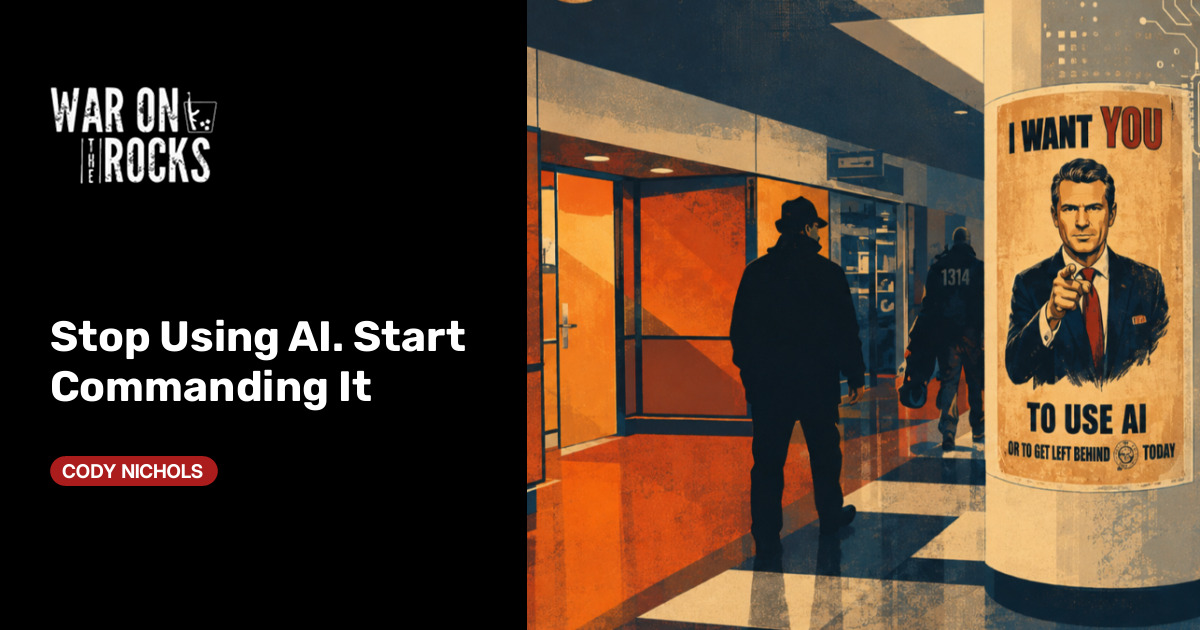
The piece argues that the Department of Defense should stop viewing AI agents as mere productivity tools and instead treat them as subordinate forces to be commanded under mission command principles. The author uses a personal “basement task force” of AI agents as an example of how humans can organize, direct, and trust agents through clear commander’s intent, decentralized execution, and built-in risk controls.
The central claim is that agentic warfighting is already here, and military leaders need a framework to understand what agents can do, qualify them through mission-based testing, and field them under human command. The author defines an agentic warfighter as a model combined with scaffolding such as memory, planning loops, and tools, placed under a human commander with a mission. He argues that readiness should be judged by task performance, not by abstract benchmark time horizons, since model capabilities are uneven and mission-specific.
The essay also warns against overreliance on remote vendor-hosted AI systems and closed frontier models. Such dependence can weaken decentralized execution, create vulnerabilities, and give vendors too much control. Instead, commanders should control models locally when possible, understand their limitations, and use guardrails, kill switches, and tool restrictions to manage risk.
Finally, the author suggests that Congress and the Pentagon are already moving toward formal command structures for autonomous systems, and warns that failing to solve the command problem could leave the U.S. behind adversaries that are centralizing their own AI military efforts.
Article timeline
Build this article’s timeline
Extract dated events, key actors, and open questions using the same timeline analysis available in Signal.
Log in to build
Timeline generation is available to signed-in community members.
Primary-source excerpts
Login to contribute excerpts from the source.
Five Ws
🤖 4 AI prefills · 1 still unanswered
Who
my wife, China, War on the Rocks, and Department of Defense
What
The piece argues that the Department of Defense should stop viewing AI agents as mere productivity tools and instead treat them as subordinate forces to be commanded under mission command principles.
When
When did this happen, or what is the timeframe?
Where
Pentagon, Maryland, and China
Why
Centers on mission command, agentic warfare, and AI agents
Login to answer and earn XP for each gap you fill.
Agentic Command mission command, subordinates, intent, commanders, execution Model Evaluation benchmarks, task results, qualification, Cybench, performance Local AI Infrastructure weights, scaffolding, Mac minis, graphics cards, local models Defense Policy Debate Pentagon, Department of Defense, Congress, directive, autonomy Vendor Dependence Risks remote cognition, closed models, vendors, cloud, China
Key Phrases:
mission command99% agentic warfare97% AI agents96% command and control95% commander's intent94% remote cognition91% closed frontier models89% scaffolding87% autonomous systems86% Robotic and Autonomous Systems Command84%
41
Manipulation Score: Medium
How much this article uses emotional framing vs. straight reporting
Loaded Language
3425%
Absolutist
4615%
Threat/Panic
3925%
Us vs Them
2815%
Engagement Bait
5220%
Manipulation score look right?
Factual Claims (10)
medium
technology
GenAI.mil hit 1.5 million users in six months.
high
other
A task force in a Maryland basement collects intelligence, develops missions, and executes against targets 24/7.
medium
technology
Six graphics cards and a stack of Mac minis host dozens of agentic warfighters.
medium
economic
Subordinates acquire underpriced AI hardware before scalpers hoard it for sale to China.
medium
technology
Model Evaluation and Threat Research measures model performance over a 16-hour time horizon.
high
technology
Anthropic’s Claude Mythos Preview solved a 30-hour robotics task six for six but failed twice on a ten-second task.
high
legal
A June 2026 national security memorandum ordered a rewrite of Directive 3000.09 to ensure autonomous systems respect the chain of command.
medium
military
The Army calls mine-detector dogs a specialized detection tool and assigns dog teams missions and readiness tracking.
medium
military
Sea Hunter tracks submarines under sparse remote supervisory control and recently moved from prototype to fleet control.
medium
legal
A draft Senate authorization could establish a unified combatant command called the Robotic and Autonomous Systems Command.
Comments
Login to view and post comments.