news
Orca
Orca — The most powerful Agent Development Environment (ADE)
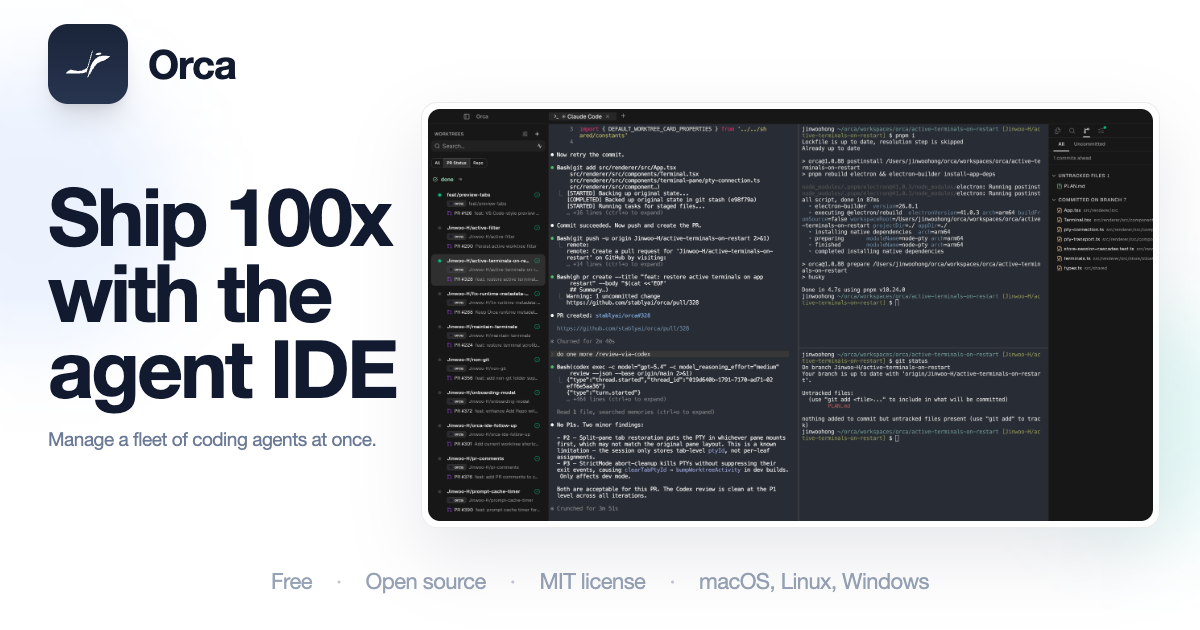
Orca is presented as a powerful Agent Development Environment (ADE) designed to help teams run and coordinate multiple AI coding agents at once. It supports popular CLI agents such as Claude Code, Codex, OpenCode, and others, and is positioned as “agent-first” infrastructure for end-to-end development. The platform emphasizes isolated worktrees, terminals, browser access, file editing, git tracking, and orchestration tools so several agents can work in parallel without branch conflicts or context switching.
A major theme is workflow automation: users can fan out one prompt across multiple agents, monitor progress, review AI output, and merge the best result. Orca also includes features such as Ghostty-inspired terminals, a built-in editor, browser-based design mode, annotation tools for AI diffs, native search across repos and tasks, and SSH-based remote workspaces. It integrates with GitHub and Linear, supports account switching and usage tracking, and offers mobile companion apps for iOS and Android so users can monitor agent status and manage work remotely.
The content also shows real usage examples: multiple projects running simultaneously, agent task summaries, test and lint results, and code changes validated through focused tests. Several testimonials from builders and developers praise Orca for its fast feedback loop, strong mobile support, and ability to manage several agent harnesses at once. Overall, Orca is positioned as a comprehensive, multi-agent development workspace built to streamline AI-assisted software shipping.
Article timeline
Build this article’s timeline
Extract dated events, key actors, and open questions using the same timeline analysis available in Signal.
Log in to build
Timeline generation is available to signed-in community members.
Primary-source excerpts
Login to contribute excerpts from the source.
Five Ws
🤖 2 AI prefills · 3 still unanswered
Who
Who are the key actors in this story?
What
Orca is presented as a powerful Agent Development Environment (ADE) designed to help teams run and coordinate multiple AI coding agents at once.
When
When did this happen, or what is the timeframe?
Where
Where did this occur?
Why
Centers on Agent Development Environment, agent IDE, and worktrees
Login to answer and earn XP for each gap you fill.
Agent IDE Features agent development environment, IDE, terminals, file editor, git tracking Multi-Agent Orchestration agents, fleet, parallel worktrees, task delegation, orchestration CLI Agent Integration Claude Code, Codex, OpenCode, Cursor, Gemini Mobile And Remote Access mobile companion, iOS, Android, TestFlight, APK Social Proof And Testimonials builders, tweets, reviews, feedback, recommendations
Key Phrases:
Agent Development Environment99% agent IDE96% worktrees95% parallel worktrees93% agent orchestration92% CLI agents91% git tracking88% terminal splits86% mobile companion84% account switcher82%
12
Manipulation Score: Low
How much this article uses emotional framing vs. straight reporting
Loaded Language
1025%
Absolutist
1815%
Threat/Panic
025%
Us vs Them
815%
Engagement Bait
2220%
Manipulation score look right?
Factual Claims (10)
medium
technology
Orca is an Agent Development Environment (ADE) backed 100x with the Agent IDE.
medium
technology
Orca can run Claude Code, Codex, OpenCode, and other CLI agents side by side.
medium
technology
Orca includes Ghostty-inspired terminals, a built-in file editor, and git tracking.
low
technology
Orca has mobile companion apps for iOS and Android.
low
technology
Orca is available on macOS, Windows, and Linux.
medium
technology
Orca can run a fleet of agents and automate tasks.
medium
technology
Orca supports worktrees, terminals, browser, and CLI in one app.
medium
technology
Orca supports SSH worktrees with auto-reconnect, port forwarding, and passphrase caching.
low
technology
Orca shows usage tracking for Claude and Codex accounts.
medium
technology
Orca has spawned 1,284 agents and created 96 PRs.
Comments
Login to view and post comments.