news
War on the Rocks
The Art of Statecraft in an Age of Strategic Failure
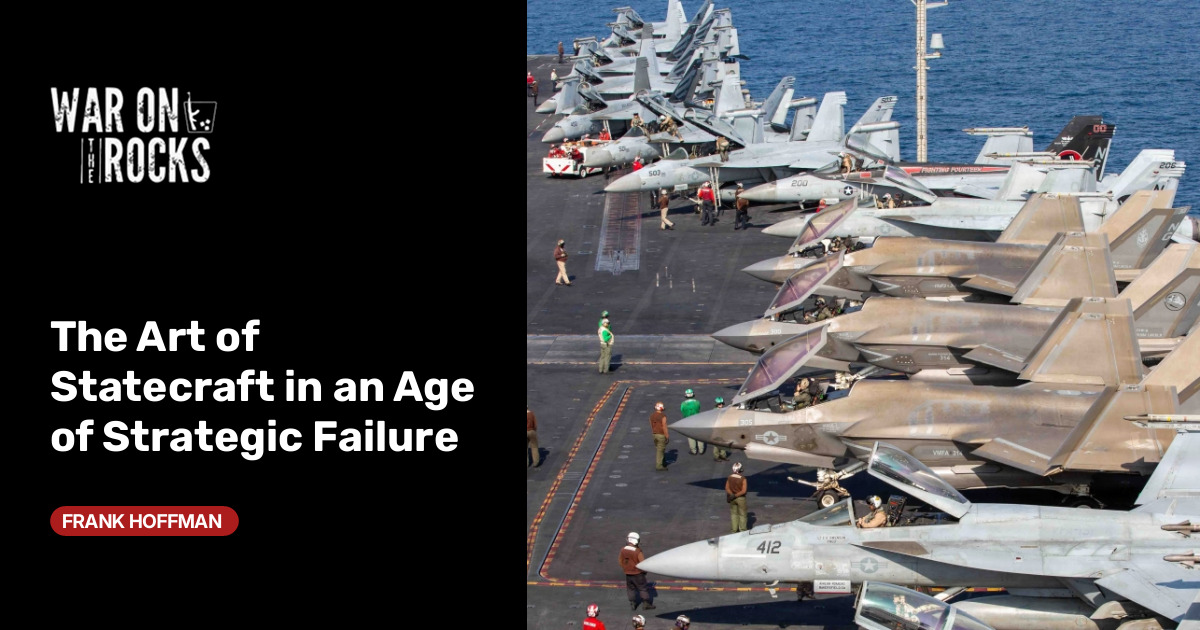
Frank Hoffman’s review argues that the recent U.S. war against Iran exposed major failures in American statecraft and strategy. He defines sound statecraft as the integrated use of all national tools to achieve desired foreign policy outcomes, and says the Iran campaign revealed weak planning, poor risk assessment, and an overreliance on military power. Hoffman doubts U.S. officials will conduct an honest after-action review, since admitting failure would invite accountability, but he says the experience should still yield lessons—especially the need for better strategy formulation, clearer theories of success, and greater appreciation of adversary agency.
He emphasizes three core strategic problems. First, a strategy must have a coherent “theory of success” that links policy goals to feasible means and ways, rather than assuming military force alone can produce political outcomes. He criticizes the idea of a “theory of victory,” which can narrow strategy into a purely military framework. Second, strategists must think in terms of multiple futures. Scenario planning helps leaders challenge assumptions, anticipate shocks, and test whether strategies remain robust under different conditions. Third, strategy must rigorously assess risk, both risks created by the strategy and risks to the strategy itself, such as regional retaliation, disruption of shipping lanes, or interference by other powers.
The review then turns to Jack Watling’s book, *Statecraft: The New Rules of Power in a Divided World*, praising it as timely and important in a worsening global security environment. Watling’s experience studying Ukraine informs his analysis of modern warfare and the evolving tools of statecraft.
Article timeline
Build this article’s timeline
Extract dated events, key actors, and open questions using the same timeline analysis available in Signal.
Log in to build
Timeline generation is available to signed-in community members.
Primary-source excerpts
Login to contribute excerpts from the source.
Five Ws
🤖 4 AI prefills · 1 still unanswered
Who
Jack Watling, Jeff Meiser, Brad Cooper, and War on the Rocks
What
Frank Hoffman’s review argues that the recent U.S.
When
When did this happen, or what is the timeframe?
Where
Washington, Iran, and Afghanistan
Why
Centers on statecraft, strategic failure, and theory of success
Login to answer and earn XP for each gap you fill.
Statecraft Failure statecraft, strategic failure, Iran, U.S. policy, foreign policy Strategic Theory strategy, theory of success, causal logic, ways and means, ends Scenario Planning multiple futures, scenarios, uncertainty, trend analysis, shocks Strategic Risk risk, mission risk, strategic risk, deterrence, allies Contemporary Statecraft Watling, book review, power, divided world, Ukraine
Key Phrases:
statecraft99% strategic failure97% theory of success95% multiple futures93% strategic risk92% scenario-based planning90% strategic logic89% Operation Epic Fury88% Iran war87% Strait of Hormuz84%
28
Manipulation Score: Low
How much this article uses emotional framing vs. straight reporting
Loaded Language
1825%
Absolutist
2215%
Threat/Panic
3025%
Us vs Them
1015%
Engagement Bait
3520%
Manipulation score look right?
Factual Claims (10)
high
geopolitical
The war against Iran exposed multiple errors and failures in U.S. statecraft.
medium
political
The U.S. government is unlikely to conduct a candid assessment of its shortcomings.
medium
geopolitical
The U.S. bureaucracy failed to learn lessons from Afghanistan and Iraq.
high
military
Operation Epic Fury involved political decapitation and military decimation aimed at Tehran's capitulation.
high
military
U.S. leaders were surprised that 13,000 sorties and targets hit did not produce unconditional surrender.
medium
military
Adm. Brad Cooper said the United States achieved all its military objectives.
high
military
The recent experience in Iran shows that shock and awe was a flawed causal hypothesis.
medium
geopolitical
Risks from the strategy included missile attacks on partners, mining of the Strait of Hormuz, and economic impacts.
medium
geopolitical
Risks to the strategy included Chinese naval intervention in the Gulf and Russian opportunism in the Baltics or elsewhere.
low
social
Jack Watling is a senior research fellow at RUSI and has produced battlefield research on Ukraine.
Comments
Login to view and post comments.