news
ECOticias.com
Germany is already testing a power plant on the Rhine equipped with 124 invisible turbines that continues to operate even after sunset and when the wind dies down
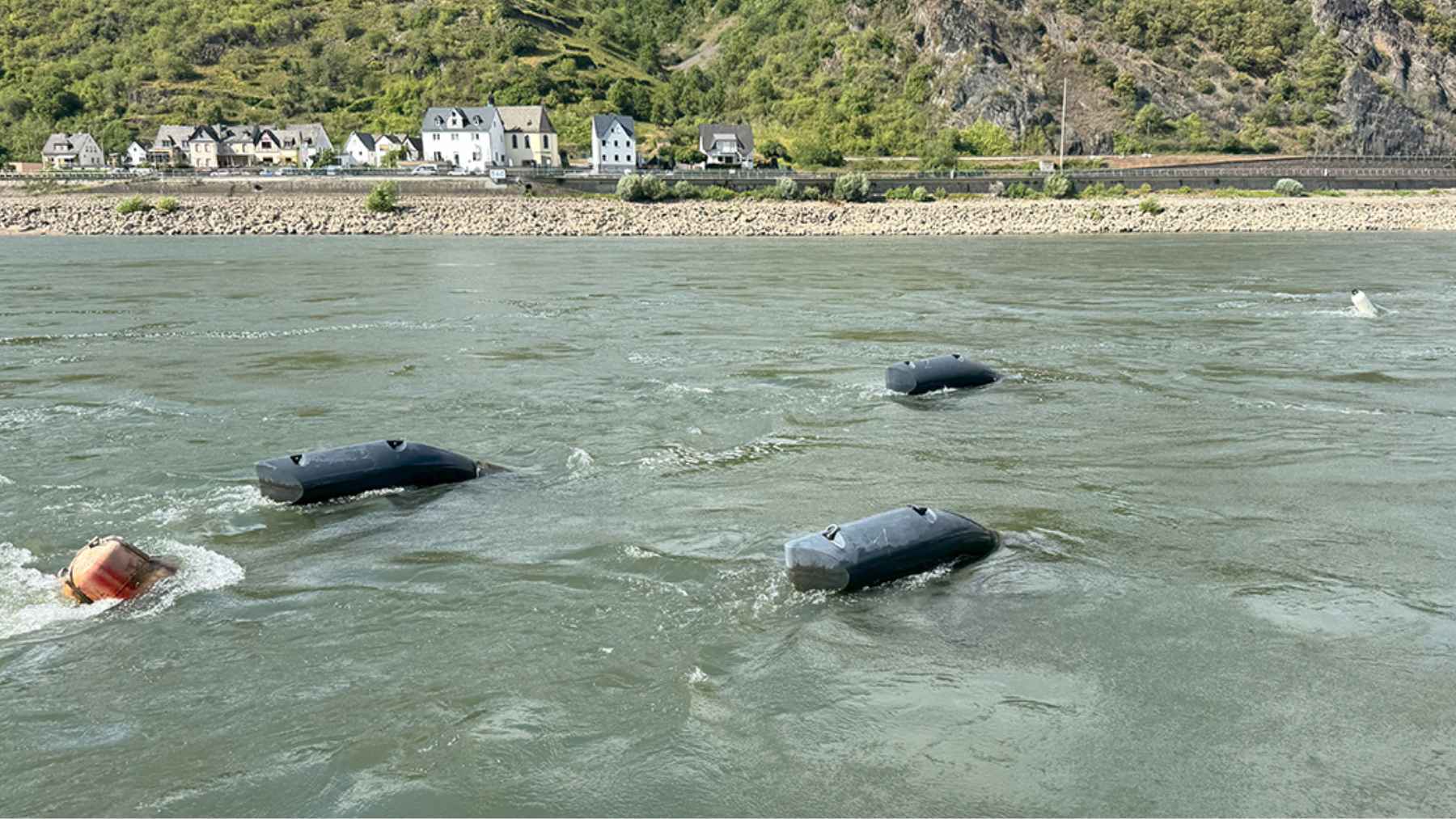
Germany is testing an innovative river-based power plant on the Middle Rhine near Sankt Goar that uses 124 small hydrokinetic turbines called “Energyfish.” Unlike traditional hydropower, the system does not require a dam or reservoir, instead generating electricity from the river’s natural current. Officials say it is the world’s first fully approved “swarm power plant” of its kind, with three turbines already operating and 21 more planned before the project expands to the full 124-unit buildout.
The turbines are designed to be small, quiet, and barely visible above the water. Each unit is about the size of a small car, can produce up to 6 kilowatts, and is built to adapt to high water or ice conditions. The Rhine section chosen for the project has a steady current of about 3.4 to 4.5 miles per hour, making it suitable for continuous generation even at night or when wind and solar output drop.
State officials estimate that 100 turbines could generate about 1.5 gigawatt-hours of electricity annually, enough for roughly 400 to 500 households, while the full project could supply more than 460 households. The project is also expected to avoid about 545 metric tons of CO2. Researchers are studying its effects on fish using sensors, sonar, and underwater video, as environmental impact remains a key concern. Supporters say the project could prove that river current energy can scale without harming nature.
Article timeline
Build this article’s timeline
Extract dated events, key actors, and open questions using the same timeline analysis available in Signal.
Log in to build
Timeline generation is available to signed-in community members.
Primary-source excerpts
Login to contribute excerpts from the source.
Five Ws
🤖 4 AI prefills · 1 still unanswered
Who
Richard Eckl, Katrin Eder, Albert Einstein, and Energyminer
What
Germany is testing an innovative river-based power plant on the Middle Rhine near Sankt Goar that uses 124 small hydrokinetic turbines called “Energyfish.” Unlike traditional hydropower, the system does not require a dam or reservoir, inst…
When
When did this happen, or what is the timeframe?
Where
Germany, Rhine, and Middle Rhine
Why
Centers on swarm power plant, hydrokinetic power, and Energyfish turbines
Login to answer and earn XP for each gap you fill.
Rhine Turbine Project Rhine, Sankt Goar, Energyfish, 124 turbines, swarm power plant Hydrokinetic Technology hydrokinetic, subsurface turbines, moving water, river flow, invisible Energy Output Economics gigawatt-hours, households, electricity cost, renewable power, carbon dioxide Environmental Impact fish migration, ecology, habitat, turbine passage, sensor fish Renewable Grid Strategy solar, wind, grid reliability, renewable electricity, energy transition
Key Phrases:
swarm power plant98% hydrokinetic power95% Energyfish turbines94% Middle Rhine91% Sankt Goar90% river currents88% renewable electricity86% local grid82% fish migration80% Technical University of Munich78%
Organizations: Energyminer2 Technical University of Munich US Department of Energy Federal Environment Agency Environment, Energy and Mobility of Rhineland-Palatinate ECOticias.com2 El Periódico Verde
Locations: Germany5 Rhine Middle Rhine5 Sankt Goar4 Rhineland-Palatinate Technical University of Munich Kobe Greenland China UK
Events: Proof of Scale
18
Manipulation Score: Low
How much this article uses emotional framing vs. straight reporting
Loaded Language
1225%
Absolutist
1815%
Threat/Panic
825%
Us vs Them
215%
Engagement Bait
4220%
Manipulation score look right?
Factual Claims (10)
medium
energy
Germany is testing a power plant on the Rhine near Sankt Goar with 124 invisible turbines.
high
energy
The project is described as the world's first fully approved 'swarm power plant' of its kind.
medium
energy
Three turbines are already operating, with 21 more planned next before scaling to 124.
medium
technology
The turbines are designed to be barely visible and almost silent once deployed.
medium
technology
Each Energyfish turbine is about 9.2 by 7.9 by 4.6 feet, weighs roughly 176 pounds, and has a maximum output of 6 kW.
medium
geographical
The Middle Rhine current at the site typically reaches about 3.4 to 4.5 miles per hour.
medium
energy
100 units could produce about 1.5 gigawatt-hours per year, enough for about 400 to 500 four-person households.
medium
energy
The full buildout could cover more than 460 households.
medium
environmental
The project could avoid about 545 metric tons of carbon dioxide based on a 2024 reference value.
medium
scientific
Researchers at the Technical University of Munich are studying fish passage effects using sensor fish, sonar, and underwater video.
Comments
Login to view and post comments.