magazine.sebastianraschka.com
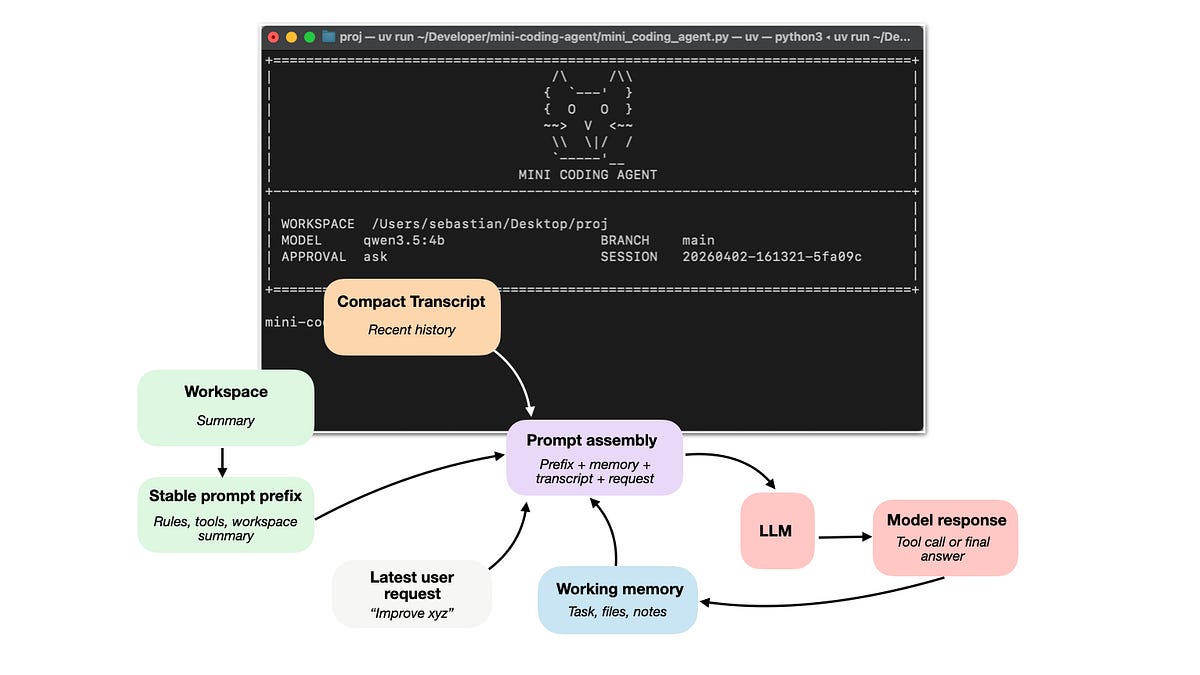
In "Components of A Coding Agent," Dr. Sebastian Raschka discusses the architecture and functionalities of coding agents, which enhance the performance of Large Language Models (LLMs) in practical applications. He emphasizes that recent advancements in LLM systems stem not only from improved models but also from effective utilization through surrounding systems, including tool use, context management, and memory. Key examples of coding agents include Claude Code and Codex CLI, which serve as application layers that improve coding efficiency.
Dr. Raschka outlines the relationship between LLMs, reasoning models, and agents, defining LLMs as core models, reasoning models as LLMs optimized for reasoning tasks, and agents as control systems that utilize LLMs alongside tools and memory. He introduces the coding harness—a specialized agent harness designed for software engineering—highlighting its role in managing code context, tool execution, and feedback loops.
The article details six essential components of coding agents: 1) Live Repo Context, which provides situational awareness of the code environment; 2) Prompt Shape and Cache Reuse, which optimizes prompt management; 3) Structured Tools, Validation, and Permissions for effective tool interaction; 4) Context Reduction and Output Management for efficient data handling; 5) Transcripts, Memory, and Resumption for session continuity; and 6) Delegation and Bounded Subagents to manage complex tasks. Overall, the coding harness significantly enhances the capabilities of both reasoning and non-reasoning models, particularly in coding contexts.
Article timeline
Build this article’s timeline
Extract dated events, key actors, and open questions using the same timeline analysis available in Signal.
Log in to build
Timeline generation is available to signed-in community members.
Primary-source excerpts
Login to contribute excerpts from the source.
Five Ws
🤖 4 AI prefills · 1 still unanswered
Who
OpenAI
What
In "Components of A Coding Agent," Dr.
When
April 04, 2026
Where
Where did this occur?
Why
Centers on coding agents, agent harness, and large language models
Login to answer and earn XP for each gap you fill.
Coding Agents Overview coding agents, LLMs, agent harness, tool use, context management Agent and Harness Components agent components, coding harness, repo context, memory, tool design LLMs vs Reasoning Models LLMs, reasoning models, next-token generation, control loop, model performance Coding Harness Functionality coding harness, context management, execution support, user experience, feedback
Key Phrases:
coding agents95% agent harness93% large language models90% repo context88% reasoning model87% coding harness85% context management84% tool design82% prompt-cache stability80% iterative feedback78%
Organizations: OpenAI
15
Manipulation Score: Low
How much this article uses emotional framing vs. straight reporting
Loaded Language
1025%
Absolutist
515%
Threat/Panic
025%
Us vs Them
015%
Engagement Bait
520%
Manipulation score look right?
Factual Claims (10)
medium
technology
Coding agents use tools, memory, and repo context to enhance LLMs.
medium
technology
Claude Code and Codex CLI are agentic coding tools that improve coding tasks.
low
technology
The agent layer decides what to inspect next and which tools to call.
medium
technology
A coding harness helps manage code context, tools, execution, and feedback.
medium
technology
The relationship between LLMs, reasoning models, and agents is crucial for performance.
medium
technology
A better LLM provides a better foundation for a reasoning model.
low
technology
Coding work involves repo navigation, search, function lookup, and error inspection.
medium
technology
The coding harness combines model family, agent loop, and runtime supports.
low
technology
The coding agent collects information before executing tasks to provide context.
medium
technology
Smart runtimes do not rebuild everything on every turn, optimizing performance.
Comments
Login to view and post comments.