news
The War Zone
Navy's Drone Ship Plans Get Shaken Up Again
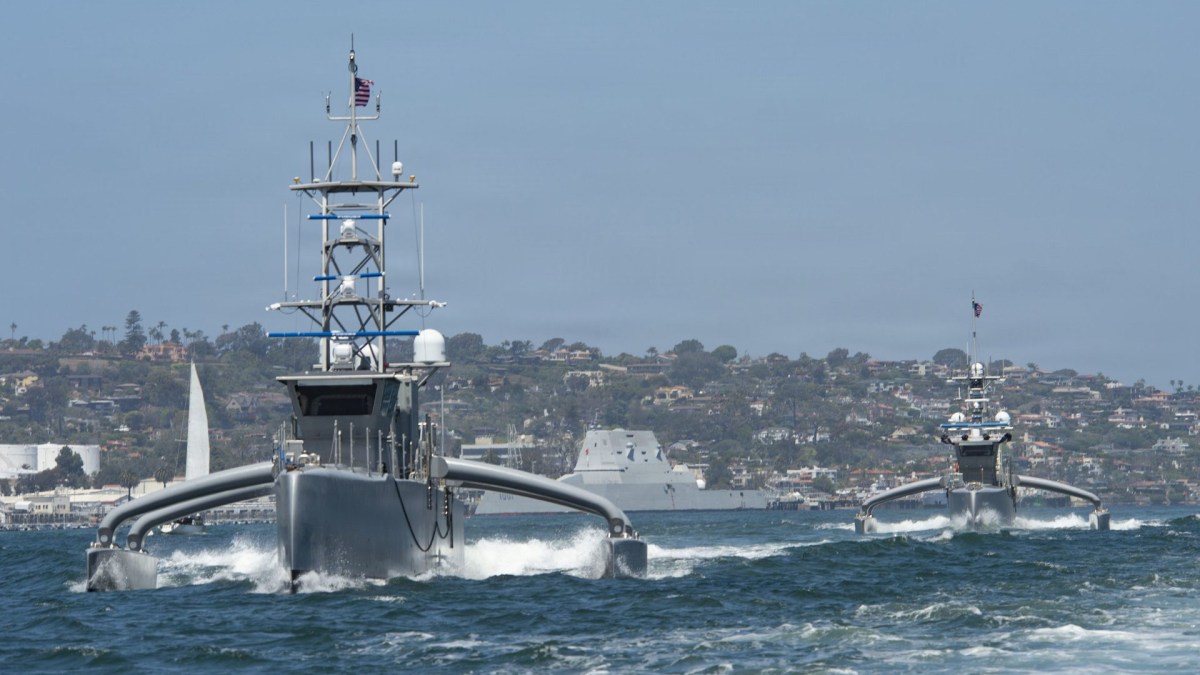
The U.S. Navy has introduced a new "marketplace" model for acquiring uncrewed surface vessels (USVs), focusing first on medium-sized designs known as Medium Unmanned Surface Vessels (MUSVs). This approach replaces the previously proposed Modular Surface Attack Craft (MASC) plan, aiming to expedite the procurement process by reducing lengthy prototyping phases. According to Secretary of the Navy John Phelan, this strategy seeks to leverage private sector innovation and investment, rewarding companies that can deliver capabilities quickly.
The Navy is looking for MUSVs that can perform a variety of missions with containerized payloads, requiring specifications such as a range of 2,500 nautical miles at 25 knots while carrying a 25 metric ton load under NATO's Sea State 4 conditions. Key operational features include full autonomy in various weather conditions and the ability to restrict radio frequency emissions. The Navy is also emphasizing the integration of open architecture standards for command and control systems.
The initiative aligns with the broader "Golden Fleet" concept, which aims for a scalable and flexible deployment model. The Navy seeks to produce between five and ten operational MUSVs by 2027, marking a shift towards a more adaptable force structure that can meet specific mission requirements. This evolution reflects the Navy's recognition of the changing character of warfare and the increasing demand for unmanned systems.
Article timeline
Build this article’s timeline
Extract dated events, key actors, and open questions using the same timeline analysis available in Signal.
Log in to build
Timeline generation is available to signed-in community members.
Primary-source excerpts
Login to contribute excerpts from the source.
Five Ws
🤖 4 AI prefills · 1 still unanswered
Who
John Phelan, Rebecca Gassler, Daryl Caudle, and U.S. Navy
What
The U.S.
When
January and 2027
Where
Where did this occur?
Why
Centers on Medium Unmanned Surface Vessel (MUSV), uncrewed surface vessels (USV), and Modular Surface Attack Craft (MASC)
Login to answer and earn XP for each gap you fill.
Uncrewed Surface Vessels USV, MUSV, autonomous, procurement, missions Acquisition Strategy marketplace, procurement, contracting, innovation, private investment Operational Requirements autonomy, capabilities, performance, testing, threshold requirements Future Warfare warfare, technology, strategy, adaptation, military
Key Phrases:
Medium Unmanned Surface Vessel (MUSV)95% uncrewed surface vessels (USV)92% Modular Surface Attack Craft (MASC)88% autonomous operations87% containerized payloads85% marketplace model83% NATO STANAG 419480% autonomy Control System78% Chief of Naval Operations (CNO)75% Golden Fleet concept73%
20
Manipulation Score: Low
How much this article uses emotional framing vs. straight reporting
Loaded Language
1025%
Absolutist
515%
Threat/Panic
525%
Us vs Them
515%
Engagement Bait
520%
Manipulation score look right?
Factual Claims (10)
medium
military
The U.S. Navy has unveiled a marketplace model for acquiring future fleets of uncrewed surface vessels.
medium
military
The Navy is applying this approach first to the procurement of medium-sized designs, or MUSVs.
medium
military
The new strategy aims to cut down on lengthy prototyping requirements.
medium
military
The Navy's goal is to create a regular, recurring marketplace for MUSVs and other classes of vessels.
medium
military
The MUSVs need to be capable of fully autonomous operations both day and night in varying weather conditions.
medium
military
The Navy is interested in the ability of the MUSV to monitor health and status and autonomously report conditions.
medium
military
The Navy has a containerized launcher capable of firing SM-6 multi-purpose missiles and Tomahawk land-attack cruise missiles.
medium
military
The Navy's initial focus for MASC was on Intelligence, Surveillance, Reconnaissance, and Targeting missions.
medium
military
Adm. Caudle announced that the Navy would be moving toward a more flexible deployment model using tailored force packages.
medium
military
The Navy's new strategy is a replacement for the Modular Surface Attack Craft (MASC) plan.
Comments
Login to view and post comments.