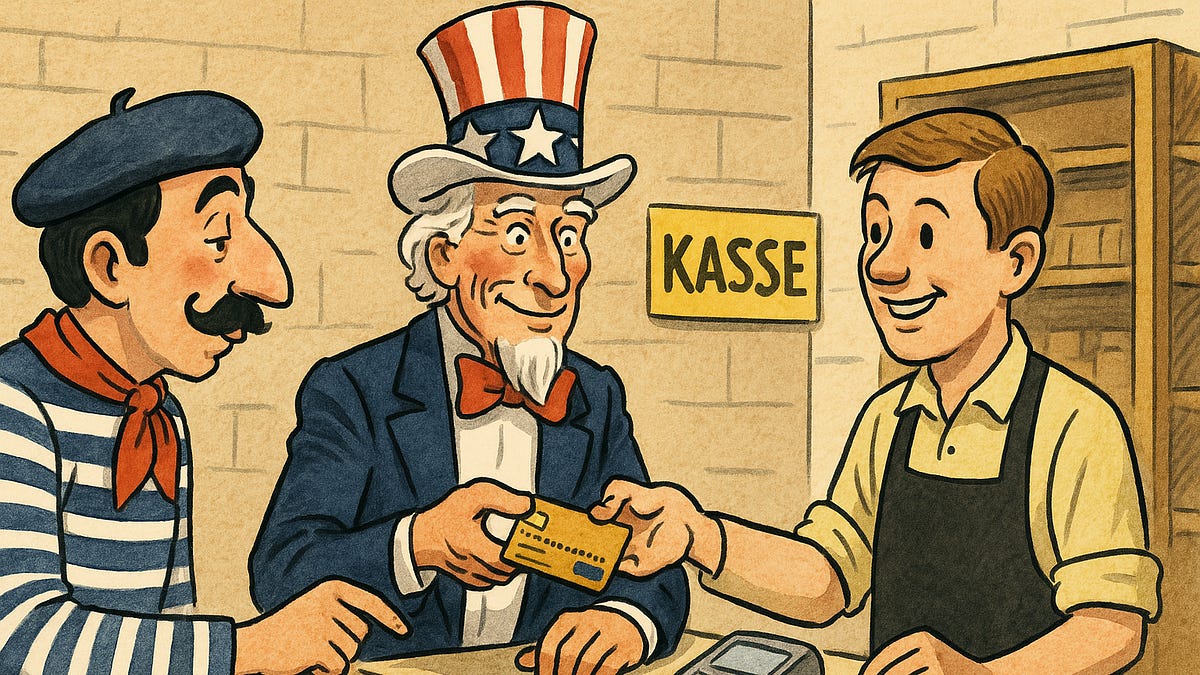
Can Europe free itself from Visa/Mastercard?
Europe's dependence on American payment systems, particularly Visa and Mastercard, poses significant risks to its economic autonomy and data security. Christine Lagarde, President of the European Central Bank, emphasized the urgent need for Europe to establish its own digital payment infrastructure. Currently, most European transactions rely on American-controlled systems, which not only facilitates the transfer of sensitive consumer data to the U.S. but also exposes Europe to potential disruptions in payment processing due to geopolitical tensions.
Despite efforts like the European Payments Initiative (EPI) aimed at unifying national payment systems, progress has been slow, hampered by fragmentation among member states and technological challenges. For example, while some local systems like Belgium's Payconiq exist, they lack cross-border functionality, forcing users to rely on American services for international transactions. Lagarde highlighted that achieving a cohesive payment solution could enhance Europe's economic wealth significantly, potentially generating over €2.8 trillion in additional GDP by 2032.
The urgency for a European payment solution is accentuated by the changing geopolitical landscape, with potential threats from the U.S. government raising concerns about the reliability of American payment systems. Lagarde calls for a focus on internal strengths and the completion of initiatives like the Capital Markets Union to consolidate and enhance Europe’s financial independence. Overall, the dependence on U.S. payment infrastructure is increasingly viewed as a vulnerability that Europe must address.
Article timeline
Build this article’s timeline
Extract dated events, key actors, and open questions using the same timeline analysis available in Signal.
Log in to build
Timeline generation is available to signed-in community members.
Primary-source excerpts
Login to contribute excerpts from the source.
Five Ws
🤖 4 AI prefills · 1 still unanswered
Who
Christine Lagarde, Donald Trump, Sam Wilkin, and European Central Bank
What
Europe's dependence on American payment systems, particularly Visa and Mastercard, poses significant risks to its economic autonomy and data security.
When
When did this happen, or what is the timeframe?
Where
Europe, United States, and Belgium
Why
Centers on European payment system, digital payment infrastructure, and economic autonomy
Login to answer and earn XP for each gap you fill.
European Payment Independence Visa, Mastercard, payment systems, economic autonomy, digital payments Challenges of Payment Integration European Payments Initiative, fragmentation, national interests, financial regulations, technological challenges Economic Impact of Payment Dependence GDP, economic growth, transaction fees, capital markets, financial independence Data Sovereignty Concerns data privacy, consumer data, breaches, geopolitical tensions, US foreign policy
Key Phrases:
European payment system95% digital payment infrastructure90% economic autonomy88% European Payments Initiative85% Capital Markets Union84% payment dependency problem82% data sovereignty80% euro instant payment rules78% Visa and Mastercard dominance76% geopolitical tensions74%
Events: Capital Markets Union
Comments
Login to view and post comments.