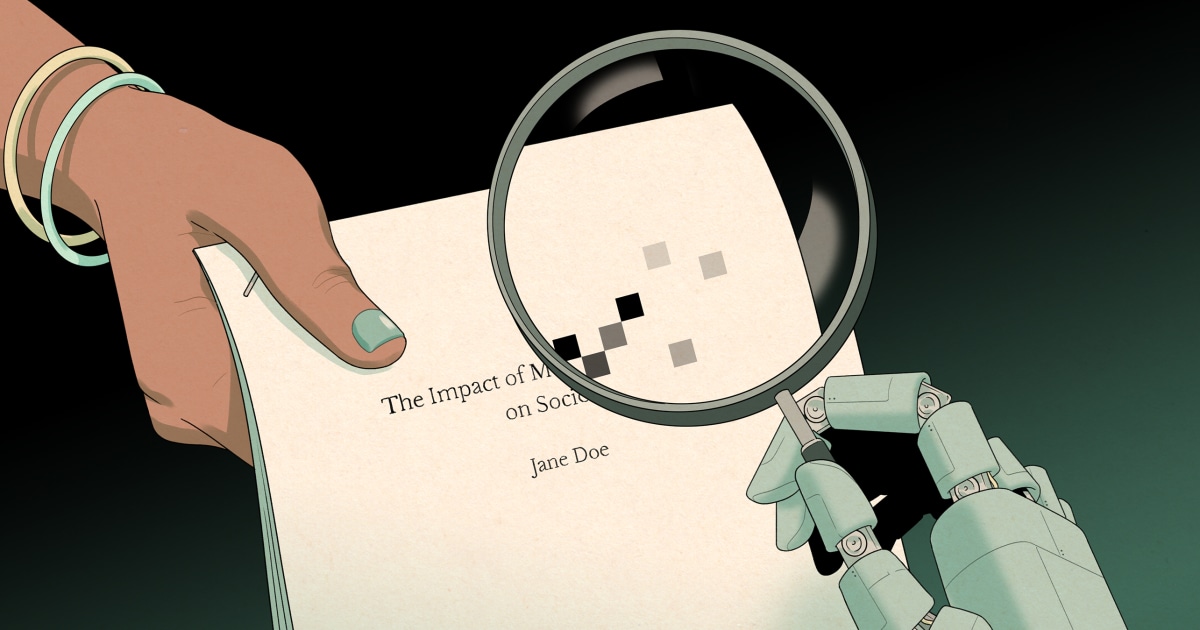
To avoid accusations of AI cheating, college students are turning to AI
The rise of generative AI on U.S. college campuses has led to heightened fears of cheating, prompting professors to use AI detectors, which have been criticized for their unreliability, especially against non-native English speakers. In response, students are utilizing "humanizers" to alter their writing and avoid detection, while some have filed lawsuits over false accusations. This ongoing cycle of detection and counter-detection highlights the pervasive impact of AI in academia, affecting both students who use it and those who do not.
Article timeline
Build this article’s timeline
Extract dated events, key actors, and open questions using the same timeline analysis available in Signal.
Log in to build
Timeline generation is available to signed-in community members.
Primary-source excerpts
Login to contribute excerpts from the source.
Five Ws
🤖 4 AI prefills · 1 still unanswered
Who
Anuj Shrestha, Erin Ramirez, Aldan Creo, and NBC News
What
The rise of generative AI on U.S.
When
When did this happen, or what is the timeframe?
Where
United States, Spain, and Virginia
Why
Centers on AI detectors, generative artificial intelligence, and humanizers
Login to answer and earn XP for each gap you fill.
AI Detection Challenges AI detectors, cheating, false accusations, plagiarism, reliability Student Responses to AI humanizers, AI tools, writing assistance, academic integrity, lawsuits Impact of AI on Education academic pressure, emotional distress, faculty concerns, AI integration, student experience Ethics of AI Usage academic honesty, ethical concerns, AI usage, integrity, conversations Humanizer Industry Growth humanizer tools, market growth, AI adaptation, text modification, academic integrity
Key Phrases:
AI detectors95% generative artificial intelligence93% humanizers90% academic integrity88% false accusations85% emotional distress83% Turnitin80% GPTZero78% writing with integrity75% AI cheating73%
People: Anuj Shrestha Erin Ramirez2 Aldan Creo2 Brittany Carr2 Edward Tian Tyler Kingkade Eric Wang Annie Chechitelli Morgan Sanchez
Comments
Login to view and post comments.